Some members of the Bank of Japan’s policy board said at a meeting earlier this month that the country’s real interest rate remains low. Although the authorities raised the benchmark interest rate at the meeting, this suggests that further rate hikes may be on the horizon in the future.
According to the minutes of the meeting released on Monday, one of the nine members of the Bank of Japan’s board said at the two-day meeting that ended on December 19th: “Japan’s real policy interest rate is currently at the lowest level globally.” The member also pointed out that considering the impact of currency fluctuations on prices, “it is appropriate for the central bank to adjust the degree of monetary easing.”
At the meeting, the board raised the benchmark interest rate to 0.75%, a 30-year high. The release of the minutes of this meeting comes at a time when the market is closely watching when the Bank of Japan might raise interest rates again. The records show that one director said that the Bank of Japan should adjust its policy at intervals of several months at present, a pace that is largely in line with the median expectation of Bank of Japan watchers.
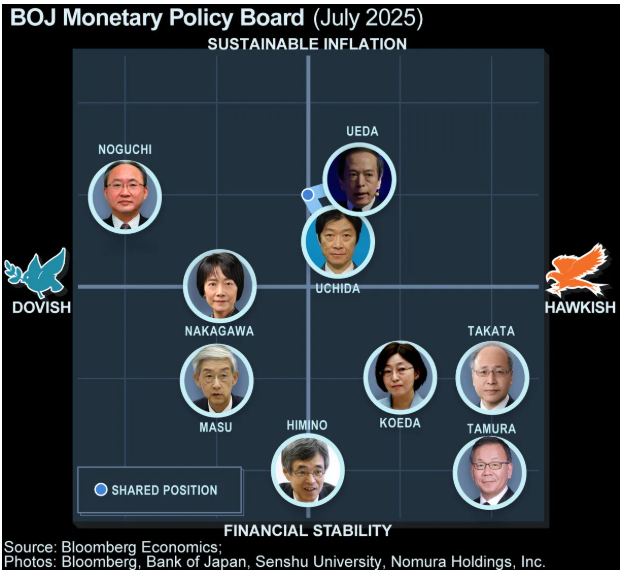
Economists surveyed by Bloomberg expect another rate hike in about six months, and many believe the final rate in this cycle will reach 1.25%. Former Bank of Japan executive director Hideo Fuchida said earlier this month that the Bank of Japan could raise interest rates to 1.50% in early 2027.
The report released on Monday clearly indicates that the policy interest rate of the Bank of Japan has not yet reached the neutral level. One member pointed out: “It can be said that there is still a considerable distance from the neutral interest rate level.”
At a press conference following the announcement of the December 19th resolution, Bank of Japan Governor Kikuo Iwata said that it is difficult to determine an appropriate level at which the policy interest rate is neither stimulative nor contractionary. A study by the Bank of Japan indicates that the neutral interest rate may lie within a broad range of 1% to 2.5%.
The summary shows that some members agreed with Ueda’s view on the neutral interest rate and pointed out the difficulty in determining the level of the neutral interest rate. One member stated that the central bank should have considerable flexibility in interpreting the neutral interest rate; another member believed that the central bank should not set specific targets but maintain flexibility in its policy approach.
Regarding the latest decision, one member stated that given the increased likelihood of the economic outlook materializing, the wage and price increase mechanism is highly likely to be maintained. Another member added that the impact of US tariffs is no longer regarded as an unprecedented risk, and it was precisely this factor that led the bank to suspend the tightening measures earlier this year.
The report also noted that some board members expressed concerns over the depreciation of the yen, which was likely one of the factors they considered before making the decision on December 19. However, the summary indicated that the yen was explicitly mentioned only once, while the impact of foreign exchange trends was referred to four times in this month’s discussions.
When the bank raised the benchmark interest rate in January, the minutes of the meeting showed that the yen was mentioned seven times and the dynamics of the foreign exchange market were mentioned twice.
The summary shows that although the government led by Prime Minister Sanae Takaichi does not oppose the latest interest rate hike by the Bank of Japan, it is cautious. A Cabinet Office official said at the meeting, “We must closely monitor the future development of factors such as corporate fixed investment and corporate profits.”
Chikako Koichi is a staunch supporter of stimulus policies and took office as prime minister in October. Her assumption of office has raised questions about whether Fumio Ueda can continue to implement normalization policies, but the political cost of inflation and the depreciation of the yen is believed to have limited the resistance to policy normalization this month.
Noboru Kiuchi, minister in charge of economic growth strategy, was one of three representatives from the Cabinet Office at the meeting. He is a founding member of a group within the ruling party that advocates for economic stimulus policies.


