The appeal of arbitrage trading is reviving among investors such as DoubleLine Capital and VanEck Associates. The stabilization of the market after the ceasefire in the Middle East has strengthened investors’ risk appetite.
Arbitrage trading refers to a trading strategy where funds are borrowed in a currency with a low interest rate and then invested in a currency with a high interest rate. The war led to an increase in oil prices, stimulating the appreciation of resource-rich currencies such as the Brazilian real and the Colombian peso, and thus the arbitrage trading flourished.
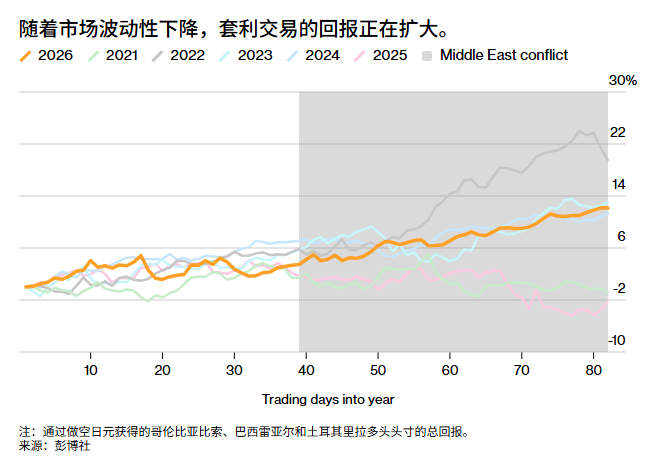
However, due to the easing of international tensions, the volatility of currencies, bonds and stocks has decreased, and arbitrage trading is currently accelerating. This environment has strengthened investors’ confidence that there will be no sharp and adverse fluctuations in exchange rates. They believe that a situation like the 2024 trading reversal that shook the entire market will not recur.
Several institutions, including Citigroup and Goldman Sachs, have been recommending various carry trade strategies in recent weeks. They maintain their previous views. A typical carry trade strategy involves raising funds in Japanese yen and investing in a basket of currencies including the Brazilian real, the Colombian peso and the Turkish lira, with an expected return of about 12% by 2026, which is the best start in nearly three years.
RBC Capital Markets strategist Luis Estrada said, “Arbitrage trading has regained dominance. The market’s rapid recovery has caused many investors to miss out on opportunities. As volatility declines, they are shifting their focus from hedging to seeking returns.”
Market turmoil has subsided and trading activity in various assets is picking up. The ceasefire agreement has boosted expectations in the bond market that US Treasuries will outperform interest rate swaps. Such trades tend to perform well in low-volatility environments. Meanwhile, the S&P 500 index hit a new all-time high this week.
Anna Wu, a cross-asset investment strategist at VanEck, said, “This might be overly optimistic, but the basic assumption is that the war is about to end.” She added, “Currencies and yields in South America are currently particularly strong because they are closely related to resources, making them ideal for carry trades.”
RBC’s Estrada suggests betting on the appreciation of the Brazilian real against the Japanese yen and the Chilean peso. Citibank recommends the Mexican peso, the real and the Turkish lira, while Goldman Sachs strategists advise clients to invest in a basket of currencies, including the lira and the Nigerian naira, and to allocate them in equal proportions against the US dollar.
John Locascio, who is in charge of Latin American currency options trading at Bank of America (BofA), said that although the Colombian peso has high volatility and low liquidity, it has gained a significant position in arbitrage strategies in recent weeks.
The Colombian peso is one of the currencies that have benefited from the view that rising oil prices will boost the economies of energy-exporting countries while hurting those that rely on fuel imports. Although oil prices have fallen from wartime peaks, they remain above pre-war levels, and this situation has not changed.


