This week, traditional safe-haven assets such as government bonds, the Japanese yen, the Swiss franc and gold failed to offer any refuge to investors.
The status of the US dollar as a safe-haven asset is increasingly being questioned, yet it is one of the few major assets that have risen. These movements indicate that market dynamics are changing at an astonishing pace. Assets once regarded as reliable safe havens have suddenly lost their appeal due to changes in central bank policies and economic growth expectations, as well as fluctuations in traders’ sentiment.
Christoph Rieger, head of interest rate and credit research at Commerzbank, said: “The flight-to-safety mood is not as strong as before. With all policy options calling for increased supply and opposing rate cuts, ‘safe assets’ no longer serve as a hedge in a crisis. Some market movements make sense, while others do not.”
U.S. Treasuries were once regarded as the safest asset in times of turmoil. But the threat of inflation caused by surging oil and gas prices has replaced this demand.
The yield on 10-year treasury bonds rose by 20 basis points this week, on track to record the biggest increase since the tariff dispute in April. This is in sharp contrast to last month, when the yield posted its biggest decline in a year.
The inflation threat means that traders also expect the extent of rate cuts to be reduced. Currently, swap contracts predict that the extent of rate cuts will be between one and two, each cut by 25 basis points, while a week ago this expectation was as high as three.
Gold prices fell by 3.5% this week, mainly due to the strengthening of the US dollar and expectations of rising interest rates. This non-interest-bearing metal is usually more attractive when interest rates are low.
Soaring energy prices, along with stronger interest rate expectations and the US dollar, led to a weakening of gold prices in the following months. This period has become a common strategy for some traders.
More than 90% of Japan’s crude oil imports rely on the Middle East, and most of it has to pass through the Strait of Hormuz, which has been effectively blocked by the war. In addition, Japanese labor unions are demanding higher wages, and inflation is also starting to intensify. This will lead to stagflation rather than the demand-driven price growth that the Bank of Japan might take, which also explains why the yen has fallen by about 1% against the US dollar this week.
Japanese Finance Minister Masahiro Kawai reaffirmed on Wednesday that the government could take action to calm excessive currency fluctuations, including through market intervention.
Antoine Martin, the deputy governor of the Swiss National Bank, said that in view of the volatile situation in the Middle East, the Swiss central bank is ready to intervene to curb the appreciation of the Swiss franc. As a result, the Swiss franc has dropped by 1.5% against the US dollar this week. He is concerned that the inflow of safe-haven funds will push up the exchange rate of the Swiss franc and suppress the inflation rate, which has been close to zero.
Barclays’ currency strategists recommend that investors buy the Swiss franc against the Japanese yen. They say that although both currencies face energy risks, the Swiss franc is in a relatively better position. Data from DTCC also shows that options trading in the Swiss franc against the US dollar indicates its resilience.
Technical analysis:
The functions of WeChat are subject to occasional restrictions. If you want to try the plugin, please leave your contact information when adding a friend so that we can add you back easily!!!
Gold: The price further cleared the liquidity below 5100 yesterday. Currently, it has rebounded and retraced to the overnight breakout range near 5130/50. There is no further movement for the time being. For today, it is suggested to pay attention to whether the pullback to 5100/5070 can stabilize, and then consider participating based on the bullish signal that emerged at that time; or wait to see if the non-farm payroll data tonight can help the price break through and stabilize above 5150. For detailed positions, please consult the plugin.
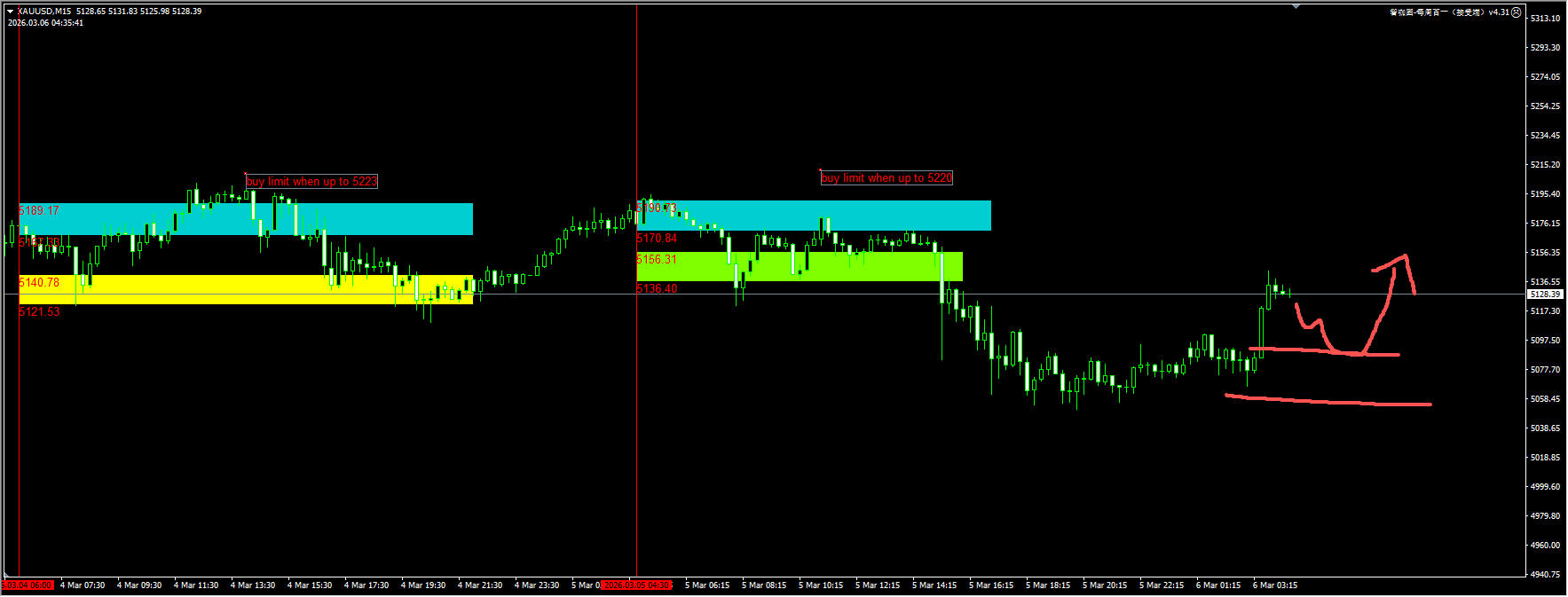
(Gold 15-minute chart)
The plugin is updated from 12:00 to 13:00 every trading day. If you want to experience the same plugin as shown in the chart, please contact V: Hana-fgfg and leave your contact information for us to get back to you.
Nasdaq: As predicted by our plugin alert yesterday, the sweeping liquidity movement in the 24,700 – 24,800 range occurred as expected. After the decline, the bullish engulfing pattern broke through and initiated a rebound. The key resistance for the day is around 25,150. A breakthrough and stabilization above this level could open up the next wave of upward movement. Alternatively, one could wait for the price to refresh the liquidity near 24,700 for a second time before considering a new long signal. For detailed positions, please consult the plugin.

(NASDAQ 15-minute chart)
The plugin is updated from 12:00 to 13:00 every trading day. If you want to experience the same plugin as shown in the chart, please contact V: Hana-fgfg and leave your contact information in the message for us to reply.
Crude oil: Yesterday, our plugin provided a clear reminder to sweep liquidity in the yellow zone, and the price movement was very consistent with it. After falling to 75.06, a pinbar formation indicating a stop of the decline was formed, and then it rose continuously to above 82. Today, continue to pay attention to the liquidity sweep near 78. After the sweep is completed, be sure to catch the new long signal that emerges. For detailed positions, please consult the plugin.

(Crude Oil 15-Minute Chart)
The plugin is updated from 12:00 to 13:00 every trading day. If you want to experience the same plugin as shown in the picture, please contact V: Hana-fgfg and leave your contact information in the message for us to reply.
Today’s key financial data and events to focus on:
21:30 US February Non-Farm Payrolls and Unemployment Rate
21:30 US January retail sales
At 23:15, San Francisco Fed President Daly and Philadelphia Fed President Harker will participate in a panel discussion on “The Value of Private Sector Data for U.S. Monetary Policy Making”.