The Japanese government confirmed in a revised report that the Japanese economy shrank in the three months ending in September, which to some extent explains the rationality of the economic stimulus plan announced by Prime Minister Saane Takaichi last month.
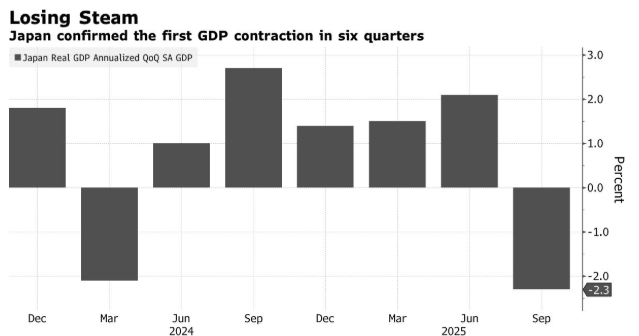
Gross domestic product (GDP) declined by 2.3% at an annual rate in the third quarter. Revised data showed that both business spending and housing investment were weaker than preliminary figures. This decline was higher than the initially announced 1.8% and marked the first drop in six quarters.
Weak economic data confirm the stimulus plan of the high market, which includes the largest increase in spending since the outbreak of the pandemic. Given that the economy had already contracted since Kaohsiung took office, these data may provide a basis for her to continue to increase spending in the future, as private consumption remains weak and other economic sectors lack growth momentum. These data add complexity to the policy decision that the Bank of Japan will make later next week, but it is unlikely to change its established course of gradual interest rate hikes.
Nomura Securities economist Uichiro Nozaki said, “Kaohsiung may use the recent economic slowdown to justify the large-scale stimulus plan.” But he added that given Japan’s output gap is almost zero, it is difficult for the high market to continue stimulating spending on the grounds of economic slowdown. I believe that after this temporary decline, the economy will return to positive growth in the next quarter.
To alleviate the inflation burden on families, Nobuo Takashi announced an economic stimulus package, planning to add 17.7 trillion yen (approximately 114 billion US dollars) in spending. The expenditure of this plan includes price relief measures such as utility subsidies and tax cuts, as well as wage support measures mainly targeting small businesses.
The government estimates that if these measures take effect within three years, the plan will increase Japan’s gross domestic product (GDP) by an average of about 1.4 percentage points each year over the next three years. Mitigating the impact of inflation on families is of vital importance to Gao Shih-ming. One of the reasons why his predecessors stepped down was the growing public dissatisfaction with the cost of living.
Meanwhile, overnight index swaps indicate that the probability of the Bank of Japan raising interest rates this month is approximately 90%. Previously, central bank governor Kazuo Ueda strongly hinted last week that borrowing costs were about to rise. Ueda made it clear that the central bank will consider raising interest rates at the upcoming meeting, which is exactly the same as the wording he used before the last rate hike in January this year. According to informed sources, if there is no major shock to the economy or financial markets during this period, officials of the Bank of Japan are ready to raise interest rates next week.
Ayako Fujita, chief Japan economist at jpmorgan Securities, said, “The Bank of Japan was supposed to raise interest rates in the autumn, but now it’s a bit behind schedule.” Just because a quarter’s data shows a slight negative economic growth does not mean that Governor Ueda’s interest rate hike in December was hard to explain.
Looking ahead, numerous risks loom over Japan’s economic outlook, including a further weakening of the yen. The exchange rate of the Japanese yen against the US dollar hovered around 155 yen, intensifying inflation and curbing private consumption. The recent tensions in China-Japan relations have also posed a threat to tourism and trade. Goldman Sachs Japanese economists estimate that the number of tourists from the Chinese mainland and Hong Kong visiting Japan may decrease by half, which will cause Japan’s economic growth rate to drop by approximately 0.2 percentage points.
Keiji Kanda, a senior economist at Daiwa Economic Research Institute, said, “In the last quarter of this year, tourism spending may be negatively affected by Sino-US relations, and Trump’s tariff policy may also curb external demand.” However, with the expected improvement in income, consumption should grow slowly. Overall, the economic growth rate will not be particularly strong, but the recovery momentum should continue.