Morgan Stanley said that the Federal Reserve led by Kevin Warsh might intensify the volatility in the US Treasury market by reducing communication with the public.
Warsh served as a Federal Reserve governor from 2006 to 2011. In May, he was nominated by President Donald Trump to succeed Jerome Powell as the chair of the Federal Reserve. Morgan Stanley’s review of the minutes of the Federal Open Market Committee meetings at that time showed that Warsh wanted investors to form their own views on economic growth, inflation and monetary policy.
Strategists Matthew Hornbach and Martin Tobias wrote in a January 30 report: “Wash doesn’t like the idea of the market being dictated by the Fed’s view,” and added, “If the market’s view differs from his, he may not necessarily support the market’s view.”
Over the past year, although the absolute level of US Treasury yields has fluctuated with changes in economic growth, the labor market and inflation, the market’s reaction to US interest rates has dropped significantly. This is largely because the market expects the Fed’s policy path to remain stable, and the Fed has also clearly expressed this expectation.
Federal Reserve Chair Powell said last October that the central bank’s monetary policy would be more effective when the public understood its content and reasons. The Fed kept interest rates unchanged last month; traders expect that Fed officials will not adjust the benchmark lending rate again until at least July.
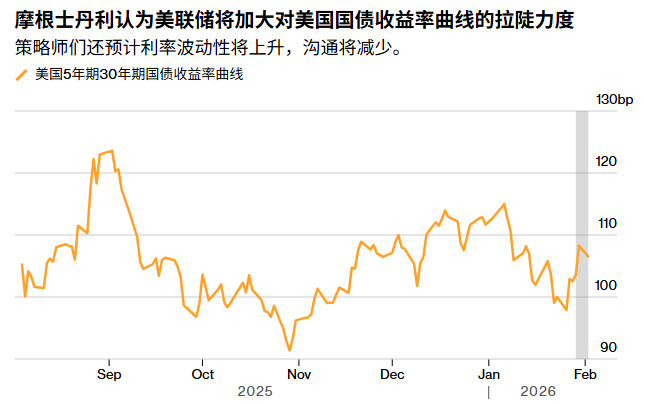
Since Warsh was nominated, traders have mainly focused on his stance on the Fed’s balance sheet or the appropriate level of policy interest rates. For instance, Morgan Stanley’s Hornbach and Tobias believe that the former governor leans towards “shrinking the balance sheet”, which would push up the level of long-term Treasury yields relative to short-term Treasury yields, that is, the so-called steepening of the yield curve.
But the bank also believes that changes in the Fed’s communication style under Waller could also heighten investor uncertainty, which is also crucial. These include Fed officials reducing their interaction with the media, especially before FOMC meetings, and scrapping the dot plot forecast or Summary of Economic Projections.
Hornbach and Tobias said, “The possibility of more surprises in monetary policy and the reduction in investor consensus on its future direction should both push up the actual volatility.”
However, not all investors are convinced that a Fed led by Warsh will necessarily lead to greater volatility in the US Treasury market. One reason is that Warsh may be more willing than other potential Fed chair candidates considered by Trump to coordinate the relationships among all members of the Fed.
“During the 2026 election, Wash may be the most likely among recent candidates to reach more consensus,” said Jeffrey Palma, head of multi-asset solutions at Cohen & Steers Inc., which manages over $90 billion in assets. “He is more likely to respond to data rather than being overly ideological.”