According to foreign exchange strategists at JPMorgan Chase, the ongoing oil price shock caused by the escalating conflict between the United States and Iran and the resulting disruption to Middle East oil tanker transportation pose the greatest threat to JPMorgan’s view that the US dollar will weaken this year.
JPMorgan has been bearish on the US dollar for months while favoring so-called high-beta currencies such as the Australian dollar and the Mexican peso, which are particularly sensitive to global risk sentiment. In a note on Monday, strategists Mira Chandran, Octavia Popescu and Patrick Locke wrote that this stance was based on the assumption that the “unprecedented turmoil” in the commodity markets was unlikely to occur, but this view has now been proven wrong.
Oil prices soared to their biggest increase in four years following the weekend air strikes by the United States and Israel on Iran. Iran promptly launched retaliatory actions, and the aftershocks of the conflict spread throughout the Middle East and the Gulf countries. US President Trump said that the air strikes on Iran might last for several weeks.
The JPMorgan team wrote: “Escalation of the conflict between the US and Israel and Iran poses a major risk to regional stability, and the foreign exchange market mainly reacts through the energy price channel.” They expect that the rise in energy prices will boost the US dollar and depress major currencies such as the euro and the Japanese yen.
JPMorgan Chase points out that there are four clear trends in the currency market related to the divergence between energy importers and exporters: Given that the United States is a net oil exporter, the US dollar has strengthened against all currencies; “Any further unwinding of the dollar short positions could provide additional tactical support.” Other oil-exporting currencies, such as the Norwegian krone, and more broadly, commodity currencies, will also be supported. The currencies of oil importers, such as the euro, the Polish zloty, the Czech koruna and the Hungarian forint, will depreciate the most, followed by the Asian foreign exchange market. Safe-haven currencies have diverged in performance, with the Japanese yen under pressure, the Swiss franc performing well, and gold emerging as a clear net beneficiary.
The question facing the market is: Is this a long-term regime change movement, similar to the situation after the U.S. invasion of Iraq in 2003? Or is it a rapid shock aimed at forcing the remaining leadership of Iran to reach an agreement?
If diplomatic efforts are quickly resumed and Iran refrains from launching attacks on energy infrastructure and shipping, the initial risk-averse sentiment may subside. However, if the conflict drags on and energy production and exports are affected, the market will have to reassess the situation of heightened volatility in oil, interest rate and foreign exchange markets, and the stock market may also suffer from stagflation as a result.
Technical analysis:
The functions of WeChat are subject to occasional restrictions. If you want to try the plugin, please leave your contact information when adding a friend so that we can add you back easily!!!
Gold: Geopolitical factors continue to simmer, and after sweeping through the demand zone of 5280/50, the price has rebounded strongly. For today, we suggest maintaining a strategy of viewing the market as volatile and bullish. If it breaks through 5400, we still recommend attempting to buy on a pullback; meanwhile, we suggest setting up long positions near 5260 after the liquidity of a low sweep. For detailed positions, please consult the plugin.

(Gold 15-minute chart)
The plugin is updated from 12:00 to 13:00 every trading day. If you want to experience the same plugin as shown in the chart, please contact V: Hana-fgfg and leave your contact information for us to get back to you.
Nasdaq: The buy stop after our plugin broke through 24,700 yesterday worked well. However, for intraday trading, we still set up strategies for low buying and low sweep liquidity. For detailed positions, please consult the plugin.

(NASDAQ 15-minute chart)
The plugin is updated from 12:00 to 13:00 every trading day. If you want to experience the same plugin as shown in the chart, please contact V: Hana-fgfg and leave your contact information in the message for us to reply.
Crude oil: The geopolitical situation continues to simmer, and the price has entered a volatile pattern at the high level at Monday’s opening. If it breaks through first within the day, one should attempt to go long; if it retracts to the lower limit of the range, observe for stabilization and then capture the rebound signal. For detailed positions, please consult the plugin.
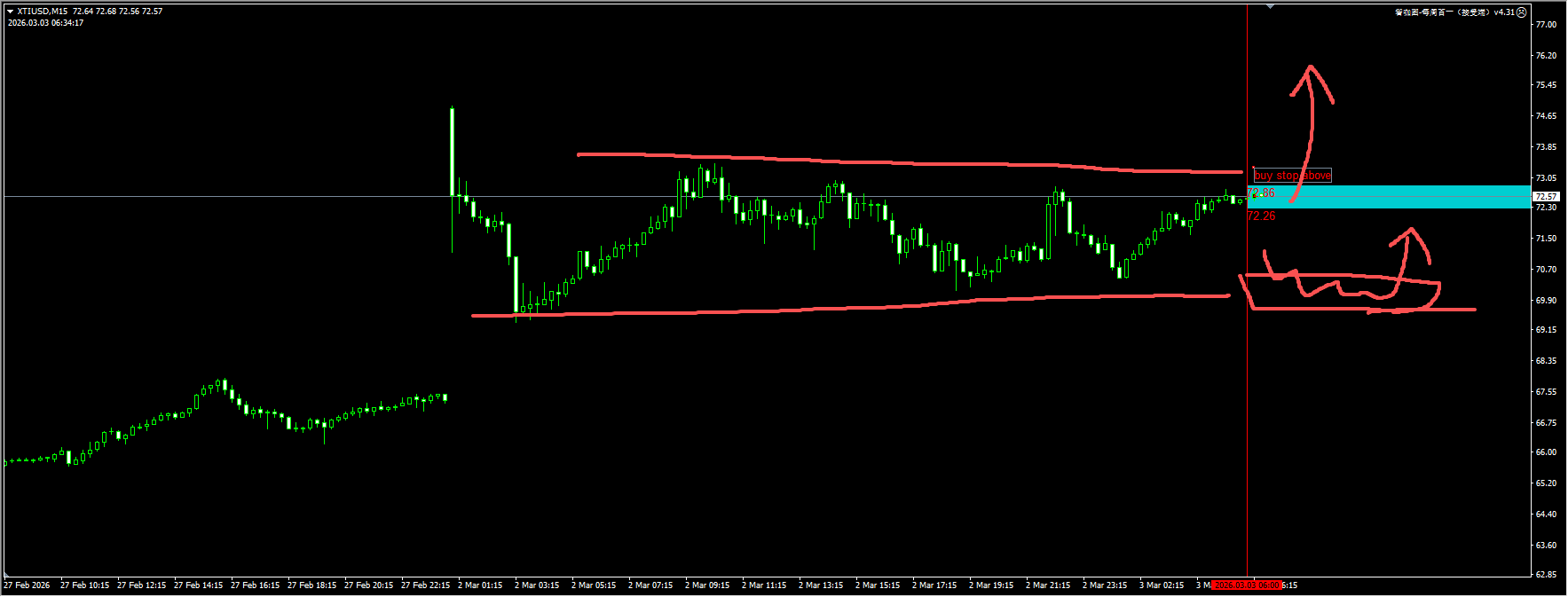
(Crude Oil 15-Minute Chart)
The plugin is updated from 12:00 to 13:00 every trading day. If you want to experience the same plugin as shown in the picture, please contact V: Hana-fgfg and leave your contact information in the message for us to get back to you.
Today’s key financial data and events to focus on:
22:00 US January Durable Goods Orders Revised (MoM)
At 22:55, William姆斯, the president of the Federal Reserve Bank of New York, will deliver a speech.