The inflation rate in the eurozone has reached its highest level since 2022 due to the sharp increase in energy costs caused by the war in Iran, which confirms expectations that the European Central Bank will have to raise interest rates.
The consumer price index rose 2.5% year-on-year in March, up from 1.9% in the previous month, reaching the highest level since January 2025. This figure was slightly lower than the median forecast of 2.6% in a Bloomberg survey.
Eurostat said on Tuesday that the core inflation rate, which excludes volatile items such as food and energy, unexpectedly slowed to 2.3%, while the closely watched inflation rate in the services sector also declined.
German government bond prices rose slightly, with the yield on 10-year bonds falling 1 basis point to 3.02%, not far from the 15-year high reached last week. Traders continue to bet that the European Central Bank will raise interest rates two to three times this year, with the first hike likely to come next month.
The conflict in the Middle East has lasted for over a month, and its impact is increasingly spreading to Europe. Not only has inflation intensified, but expectations for the trend of prices have also risen significantly.
Governments and central banks in the region have also lowered their economic growth expectations, and enterprises are preparing to deal with the situation of declining customer demand.
The European Central Bank said it would not allow the inflation surge that occurred after Russia’s invasion of Ukraine in 2022 to happen again and vowed to act quickly and decisively as needed. However, as it remains unclear when the conflict will end, officials are still assessing the damage.
High oil and gas prices have cast doubt on the European Central Bank’s benchmark expectation of an average inflation rate of 2.6% this year. In more extreme scenarios, the price increase could reach as high as 6.3% by 2027.
Estonian central bank governor Madis Muller said in Tallinn on Tuesday: “Today we can say that the basic scenario set on March 11 may be regarded as an optimistic one. If energy prices remain high for a long time, of course we cannot rule out the possibility of adjusting interest rates in April.”
The European Central Bank is powerless to stop the wild fluctuations in the energy market, so it has focused on preventing second-round effects, such as excessive wage and commodity price hikes. It is also concerned that this could have a chain reaction on goods and services that affect household consumption, such as fertilizer and food prices.
A survey released on Monday showed that consumer inflation expectations rose sharply in March, and businesses also expect to raise prices significantly. Market indicators have also responded. Long-term inflation swaps rose sharply at the beginning of the crisis, but the gains have since moderated as traders began to factor in expectations of interest rate hikes into prices.
Boris Vujčić, the governor of the Croatian National Bank, said that the view of accelerating inflation “is in line with our expectations”, while Fabio Panetta, the governor of the Bank of Italy, said, “It is crucial to closely monitor market expectations and prevent a wage-price spiral, while ensuring that monetary policy actions remain moderate.”
Their Bulgarian colleague, Dimitar Radev, believes that past inflation shocks have left a “lasting mark” on European consumers and emphasizes that “what was previously regarded as external developments is now directly affecting inflation expectations, energy prices, financing conditions and broader confidence.”
In his speech delivered on Tuesday, he said that the risks to the inflation outlook are not only high but also asymmetric and closely related to geopolitical developments.
Technical analysis:
The functions of WeChat are subject to occasional restrictions. If you want to experience the plugin, please leave your contact information when adding a friend so that we can add you back easily!!!
Gold: Yesterday, the price retraced into the yellow liquidity sweep area as alerted by our plugin, and a clear rebound and upward signal occurred. This morning, the price once touched above 4700. Today, we closely monitor the price’s retest of the 4530/4550 area. If it can stabilize, we can consider the newly emerged long signal. For detailed positions, please consult the plugin.
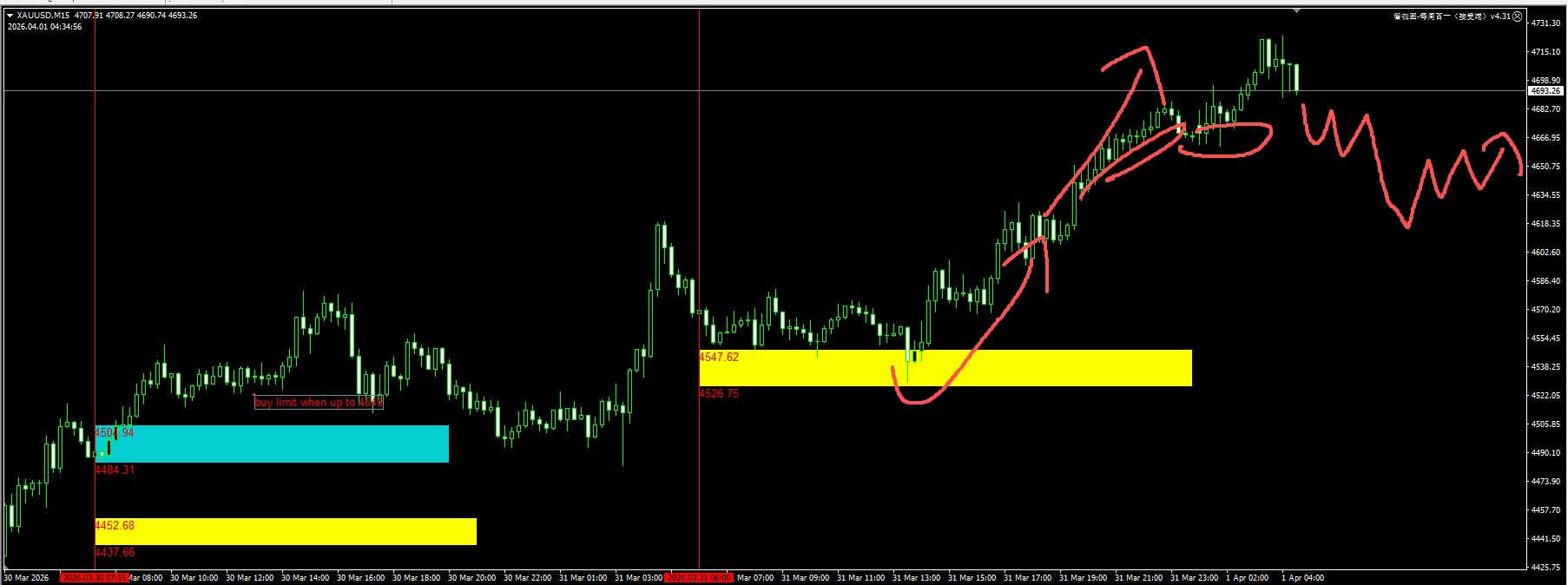
(Gold 15-minute chart)
The plugin is updated from 12:00 to 13:00 every trading day. If you want to experience the same plugin as shown in the chart, please contact V: Hana-fgfg and leave your contact information for us to get back to you.
Nasdaq: The buy limit operation in the green area we alerted yesterday through the plugin achieved a profit-to-loss ratio of approximately 9:1. Today, we will monitor whether the price needs to retrace to the liquidity at 23,500/23,550. If there is a retracement, we will continue to watch for subsequent rebound signals. For detailed positions, please consult the plugin.
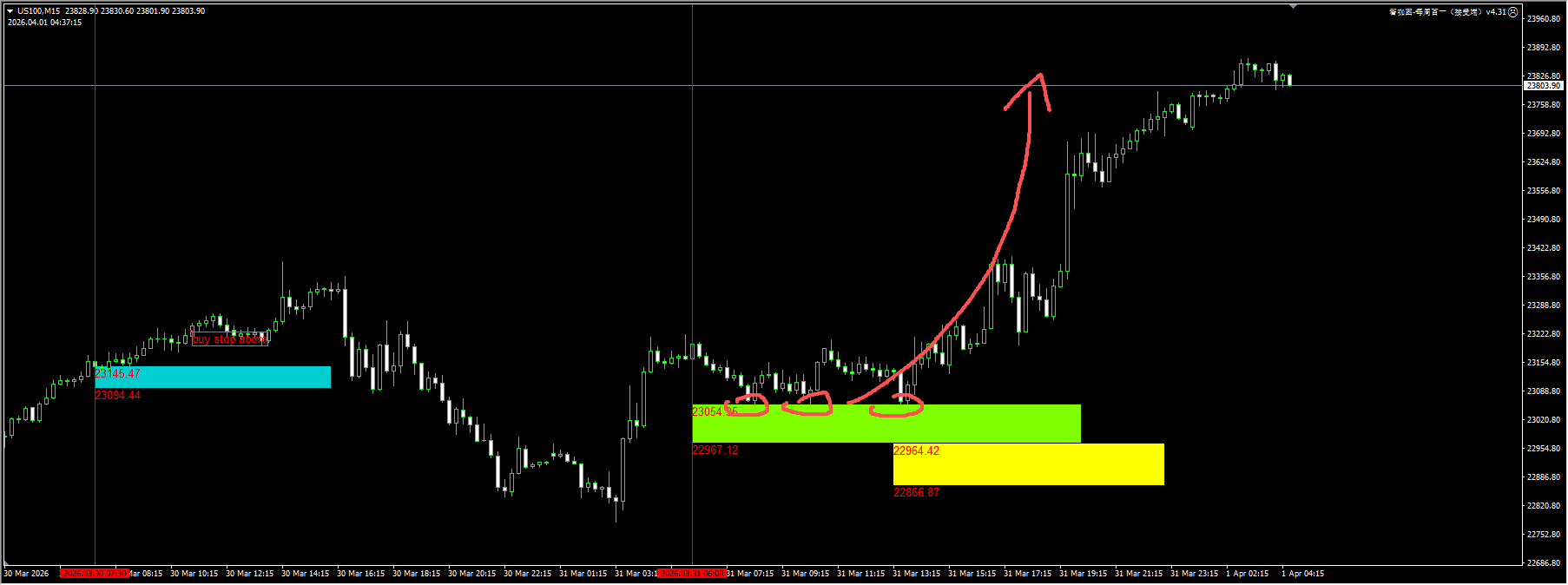
(NASDAQ 15-minute chart)
The plugin is updated from 12:00 to 13:00 every trading day. If you want to experience the same plugin as shown in the chart, please contact V: Hana-fgfg and leave your contact information in the message for us to get back to you.
Crude oil: Both the United States and Iran have simultaneously sent out signals to ease tensions. After the upward movement was blocked, the current price is showing a wedge consolidation pattern. If a downward breakout occurs, a reasonable operation would be to wait for a rebound and attempt to sell. For detailed positions, please consult the plugin.
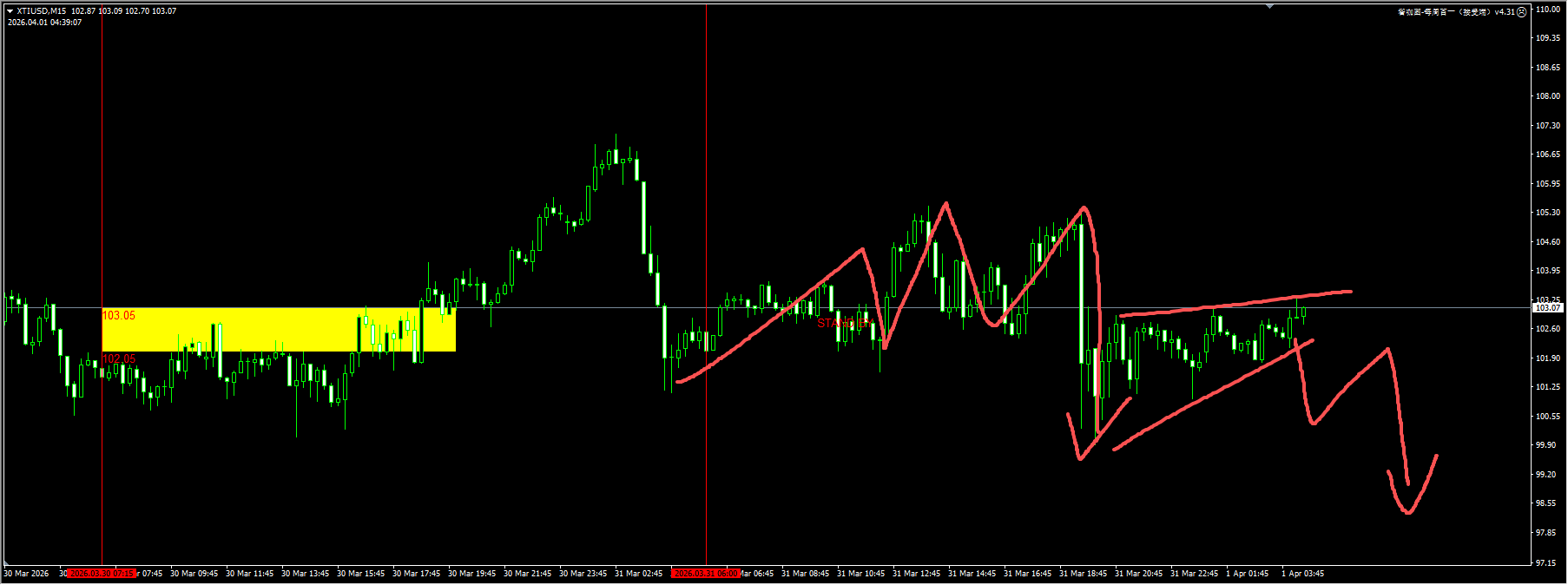
(Crude Oil 15-Minute Chart)
The plugin is updated from 12:00 to 13:00 every trading day. If you want to experience the same plugin as shown in the picture, please contact V: Hana-fgfg and leave your contact information in the message for us to get back to you.
Today’s key economic data and events to focus on:
Eurozone unemployment rate for February at 17:00
20:15 US March ADP Employment Change (thousands)
20:30 US Retail Sales MoM for February
22:00 U.S. March ISM Manufacturing PMI
