Wall Street strategists say that the Federal Reserve led by Kevin Warsh could push the $31 trillion US Treasury market out of its narrow trading range, urging investors to prepare for short-term yields to eventually fall.
On Monday, US Treasury yields rose by 2 to 3 basis points, on track to record the narrowest monthly range since the end of 2020. The 10-year yield rose 3 basis points to 4.33% as negotiations between the US and Iran to end the war have stalled and the market widely expects the Federal Reserve to keep interest rates unchanged this week.
At least in the cash bond market, this low-volatility environment has led strategists to start looking at longer-term catalysts, as former Fed governor Waller faces a vote this week to succeed Jerome Powell as Fed chair.
Morgan Stanley strategists Matthew Hornbach and others believe that the Fed led by Powell may set new inflation targets, reduce forward guidance to the market and push for balance sheet reduction – which “could intensify volatility between meetings”. They and other Wall Street figures expect short-term yields to rise and the so-called “steepening of the yield curve” trade to recover.
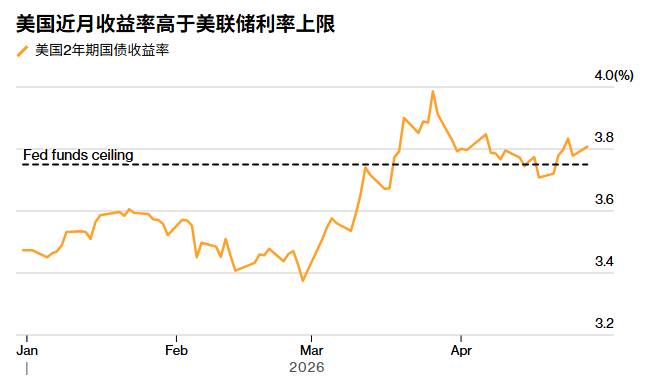
However, the bond market has remained largely stable after the sharp decline last month. High oil prices are seen as an inflation risk, and if they persist, they could eventually harm economic growth and weigh on the economy. Fund managers will be closely watching Powell’s remarks at this week’s meeting for clues on how the central bank assesses the impact of the war on the economy.
Traders tend to expect a rate cut by the end of the year, with a 0.25 percentage point reduction anticipated at the December meeting, amounting to an 8 basis point cut. Rate cuts are generally believed to lower short-term yields and help widen the spread between short-term and long-term (10-year and 30-year) bonds.
Robert Tipp, global head of fixed income and chief investment strategist at PGIM, said: “Fed officials will try to buy time because they see the economic situation as quite strong and inflation above the target level. They want to avoid shocking the market and avoid inadvertently tightening financial conditions.”
At present, he believes that the risk of short-term treasury bonds depends on the impact of the conflict on economic data. Investors will pay attention to the inflation indicators to be released by the Federal Reserve on Thursday.
This week, the slightly weak tone of the market has prompted bidders to actively participate in the issuance of $69 billion two-year Treasury bonds and $70 billion five-year Treasury bonds. Additionally, the auction of $44 billion seven-year Treasury bonds will be held on Tuesday.
This week, a series of events including the situation between Iran and the United States, economic data and major earnings releases are intertwined. Any one of them could trigger market volatility, said Jack McIntyre, portfolio manager at Brandywine Global Investment Management. “It will be very difficult for the Federal Reserve to influence market expectations,” he added.


