Despite US President Trump’s promise to end the conflict in Ukraine within 24 hours of returning to work in January, the Russian war in Ukraine continues. If Trump successfully mediates a peace agreement, the agreement must address the future of the occupied territories in Ukraine.
Last November, US and Russian officials proposed a draft peace agreement that would require Ukraine to cede large tracts of territory to Russia, abandon any hope of joining NATO, and reduce its armed forces.
The proposal put forward by the United States and Russia states that Crimea and the Donetsk and Luhansk regions will be “recognized as de facto Russian territory, including by the United States.” Ukraine must withdraw its troops from the Donetsk region it currently controls, which will become an internationally recognized “neutral demilitarized buffer zone” belonging to Russia. According to the terms of the agreement, Russian troops are not allowed to enter this area.
In other regions, control over Kherson and Zaporizhzhia will be frozen along the contact line between Russian and Ukrainian forces, which in effect means mutual recognition of that line. Russia will give up control of “other agreed-upon territories” it holds outside the five regions mentioned above.
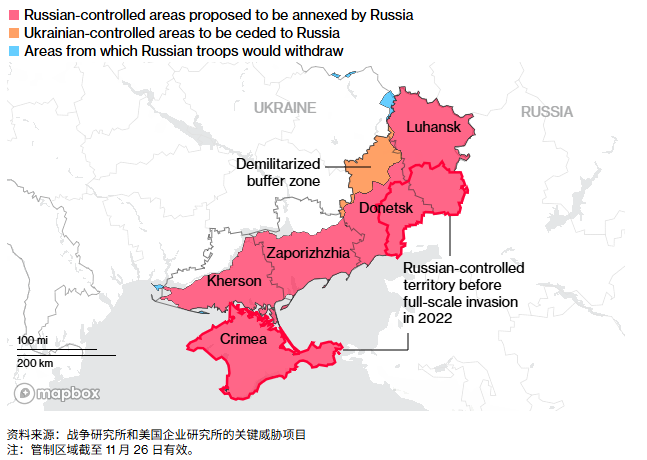
The updated framework proposed by Trump’s special envoy after meeting with Russian and Ukrainian officials is more acceptable to Ukraine as it removes the Russian demand for amnesty for war crimes. However, there are still some differences between the two sides, including the requirement that Ukraine effectively recognize Crimea, Donetsk and Luhansk as Russian territory.
Zelensky has repeatedly stated that Kyiv will never recognize the occupied territories as belonging to Russia. He cited the Ukrainian Constitution adopted in 1996, which stipulates that the country’s territory is “indivisible and inviolable”. The constitution also clearly states that Crimea is an autonomous republic and an “inalienable part of Ukraine”.
If it can bring lasting peace and security to his country, his government now seems willing to accept Russia’s effective control over most of the territory currently held by Putin’s forces.
The initial peace plan stipulated that the United States would provide security guarantees to Ukraine and receive compensation in return to prevent Russia from further attempts to seize more territory. Zelensky and his European allies have consistently maintained that any discussion of territorial exchanges can only take place after the current frontline war ends. The Washington-based think tank, the Institute for the Study of War, pointed out that if Ukraine were to give up the entire Donetsk province, it would be left in a nearly indefensible position if Russia were to launch another attack.
ISW stated that if Ukraine’s “fortress belt” (the main defense works that have long prevented Russian troops from penetrating deep into the country) were placed in a demilitarized buffer zone without fortification, it would be easily occupied by Putin’s forces.
Most Ukrainians oppose giving up territory, but as the war drags on, this support has weakened. A public opinion survey conducted by the Kyiv International Institute of Sociology in May 2022 showed that about 82% of Ukrainians said that even if the war would be prolonged and the country’s independence was threatened, they should not give up any territory. However, by early October this year, this proportion had dropped to 54%.
European leaders, as well as Canada and Japan, members of the Group of Seven, reaffirmed that international borders must never be changed by force.
But Ukrainian leader Zelensky is under tremendous pressure from Trump, and he is forced to accept unsatisfactory terms and end the war. The Ukrainian people are enduring rotating power outages and continuous deadly air strikes from Russia, which aim to crush their morale before winter comes. Moreover, Zelensky is also in a difficult position domestically due to a corruption scandal involving some senior government officials.
The Trump administration threatened that it would stop providing weapons to Ukraine and cease intelligence sharing unless Zelensky accepted the agreement – and intelligence sharing is crucial for Ukraine’s air defense. Meanwhile, the EU’s efforts to provide key financial assistance to Ukraine to help it sustain the war are also facing uncertainties. There are differences within the EU on how to use frozen Russian assets to provide a 90 billion euro ($105 billion) loan to Kyiv.
The regions of Ukraine occupied by Russia, including the Donbas region, also contain other natural resources such as lithium, titanium and graphite – although it is not yet clear how much of these resources can be commercially exploited. The Donetsk region has shale gas deposits. In 2013, Shell signed an agreement with a Ukrainian state-owned enterprise to jointly develop the deposits, but later withdrew from the agreement.
Given Ukraine’s mineral resource potential, the Trump administration signed an agreement with the Zelensky government this year, which grants the United States the right to priority exploitation of Ukraine’s natural resources in the future and a portion of the profits.
Donetsk also holds significant strategic military value. Mariupol, located in the southern part of the region, under Russian control, enables Putin to establish a land corridor from the Russian border along the coast of the Sea of Azov to Crimea.