Despite the soaring oil prices causing traders to scale back their bets on how much the policymakers will lower borrowing costs this year, Morgan Stanley still holds firm to its prediction that the Federal Reserve will resume cutting interest rates in June and do so again in September.
“We still expect in June and September, of course, there is a risk of delay,” Morgan Stanley’s chief U.S. economist Michael Gapen told Bloomberg News at a roundtable discussion in New York on Monday.
This prediction runs counter to market expectations. The market has quickly ruled out the possibility of a rate cut because the sharp rise in oil prices following the Iran war could reignite inflation, which might hamper the Fed’s ability to ease monetary policy.
Futures linked to the Federal Reserve’s policy rate now expect a 0.25 basis point cut in December, down from expectations of at least a 50 basis point cut last month. The probability of a 0.25 basis point cut in September is 60%. Economists at TD Securities and Barclays both pushed back their forecast for the Fed’s next rate cut from June to September last week.
Meanwhile, last week, US Treasuries suffered a sharp sell-off, pushing the yield on the two-year Treasury note, which is highly sensitive to policy, to nearly 3.75%, surpassing the rate the Federal Reserve pays on reserves – a level rarely breached. The terminal rate, a market indicator used to gauge the ultimate interest rate in the current loose cycle of the Federal Reserve, has risen by about 50 basis points since the end of February, exceeding 3.4%.
“The extent of the movement in the two-year rate took me by surprise. Although I can of course understand the movement in the long-term rate, what again surprised me was that the final rate was repriced so high,” Gabban said.
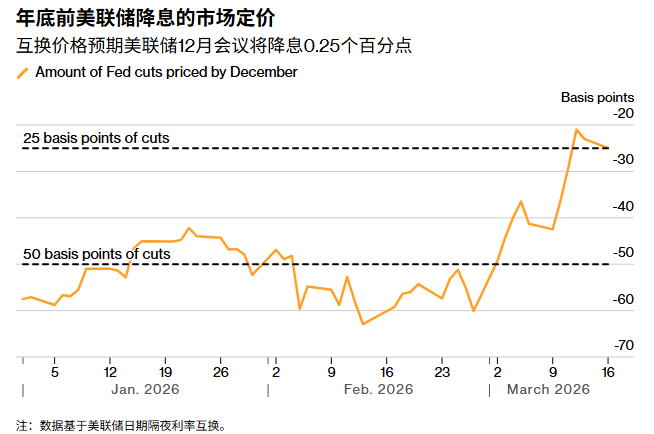
Gabon said that, of course, the central bank might postpone the first rate cut until September or even December, and either scenario could push the next rate cut to 2027. “The main risk to our view is that the later the Fed waits, the more rate cuts it may need.”
Morgan Stanley said that if energy prices remain at a high level of $125 to $150 per barrel for a long time, it will curb consumer spending and require support from the Federal Reserve. Data shows that the possibility of a U.S. economic recession has risen from 10% before the outbreak of the military conflict to about 20%.
He said, “The economy can bear a price of $90 to $100 per barrel. But if the oil price remains at around $125 to $150 per barrel for a long time, that could potentially trigger an economic recession.”
Seth Carpenter, the global chief economist of Morgan Stanley, said that the inflation surge caused by the rise in oil prices might only be temporary.
“If the situation deteriorates to the point where it starts to affect economic growth, then over time it will actually lower the potential inflation trend, especially the core inflation trend,” he said.
Matthew Hornbach, the global head of macro strategy at Morgan Stanley, said that inflation swaps could be a way to measure the extent to which high oil prices are affecting demand.
Since crude oil prices first broke through $100 per barrel since 2022, the one-year forward inflation swap rate has risen by about 20 basis points, approaching 2.5%. Hornbach said that a decline in interest rates would send a signal to buy US Treasuries and expect more rate cuts in the future, as the market is shifting from concerns about inflation to concerns about shrinking demand.


