In early 2026, China’s strong demand for silver pushed overseas silver purchases to their highest level in eight years, as importers met the surging industrial and investment demands.
According to data released by China’s customs on Friday, as the world’s largest metal buyer, China imported over 790 tons of metals in the first two months of this year, with nearly 470 tons imported in February, setting a new record high for that month. Strong demand has pushed domestic metal prices far above international benchmark prices, further depleting already low exchange inventories and prompting China to purchase large amounts of metals from abroad.
The price of silver has fluctuated sharply at the beginning of the year, never so intensely. Driven by speculative buying in China and other regions, the price of silver once soared by about 70%, but suddenly gave up its gains at the end of January. Strong import data indicates that despite changes in trade flows, China’s physical silver consumption remains stable.
Demand came from both a flood of retail investors (who bought silver bars as an alternative to increasingly expensive gold) and solar manufacturers ramping up production ahead of the expiration of a tax credit for exports on April 1. The solar industry consumed about one-fifth of annual supply, and the vast majority of solar products are made in China.
Rona O’Connell, head of market analysis for Europe, the Middle East, Africa and Asia at StoneX Group, said that the demand for physical bars is very strong and solar cell manufacturers are “booming”. “At the same time, inventories at Chinese exchanges have been declining, which in itself has created a psychological effect.”
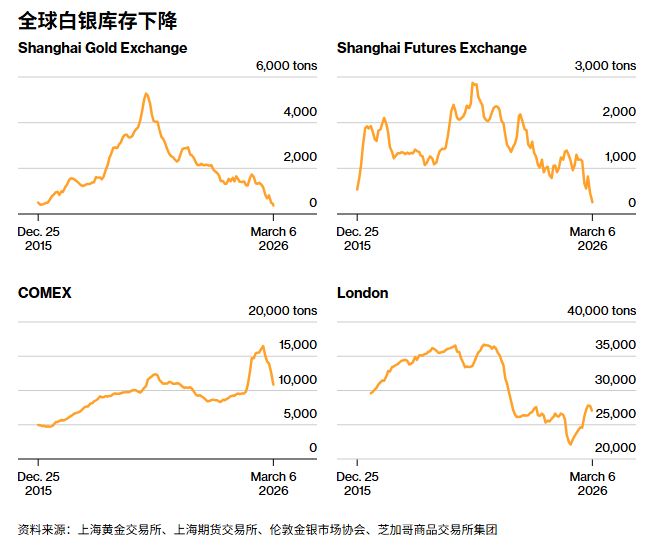
This year, a large amount of silver has flowed into London, the global trading center, after a historic contraction in supply last year. As a result, China’s huge imports have not yet impacted the London market. In addition, the amount of silver held by global exchange-traded funds (ETFs) has decreased (by more than 1,900 tons this year), which has also released more silver supply.
“Despite strong demand for silver in China, the London market has performed very well,” said Daniel Ghali, senior commodity strategist at TD Securities. “For the first time in over a year, the market has been able to handle such a large demand without causing significant price fluctuations or disruptions.”
The abundant supply of silver in London has led to a decline in the cost of borrowing silver, but due to price fluctuations and the need to guard against another supply crunch, long-term leasing remains relatively expensive.
Visible inventories of metals tracked by major exchanges from New York to Shanghai are either declining or far below long-term averages, indicating that metals remain in short supply in the overall market system. There is reason for the market to be concerned.
Simone Knobloch, the chief operating officer of Valcambi SA, a large Swiss refinery, said, “China is one of the world’s most important markets for industrial consumption and investment in silver. Feedback from the market indicates that consumers have a strong interest in physical silver products.”


