John Williams, president of the Federal Reserve Bank of New York, said that although he expects the rise in energy costs due to the war in Iran to push up overall inflation, his outlook for underlying price pressures in the United States remains largely unchanged.
Williams said in an interview with Bloomberg Television on Tuesday that core inflation “hasn’t changed much.” He also added that he expected the core inflation rate, which excludes food and energy prices, to rise by only 0.1 to 0.2 percentage points.
Williams said he has slightly lowered his forecast for U.S. economic growth in 2026 to 2% to 2.5%. Before the war, he had projected a growth rate of 2.5% to 2.75%. He also expects the overall inflation rate to rise.
A survey released by the Federal Reserve Bank of New York on Tuesday showed that short-term inflation expectations rose in March by the most in a year as consumers anticipated higher prices for gasoline and food due to the outbreak of the Middle East war.
According to the median results of the New York Federal Reserve Bank’s monthly consumer expectations survey, American consumers expect the inflation rate over the next 12 months to be 3.4%, an increase of 0.4 percentage points from February. The inflation expectation for three years later has slightly risen to 3.1%, while the inflation expectation for five years later remains unchanged at 3%.
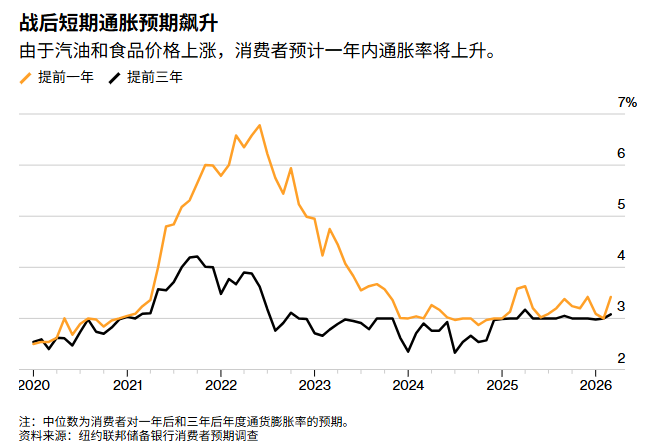
The survey conducted from March 2nd to 31st revealed that consumer pressure rose after the United States and Israel launched their first strike against Iran.
Williams said there was no need to consider any adjustment to the Federal Reserve’s benchmark interest rate.
He said, “The current monetary policy situation is very favorable,” and it is possible to wait and see the economic consequences of the Middle East conflict. “Monetary policy is in the right place. If the situation changes, we can respond.”
The war in Iran is testing the Federal Reserve’s dual mandate. Soaring energy prices could drag down economic growth and exacerbate inflation. There is no sign of easing in the conflict and its restrictions on global oil supplies. The Trump administration has threatened to launch attacks on Iran’s civilian infrastructure starting from Tuesday.
Several Federal Reserve officials, including Chair Jerome Powell, have said that the current interest rate level is sufficient to balance the rising risks in the short term.
Williams said that after the unexpectedly strong jobs report in March pushed the unemployment rate down to 4.3%, he was more confident about the US labor market.
Williams said, “What we are seeing now in the labor market is a more stable situation. It is definitely not a weak labor market.”
When asked who would lead the Federal Reserve’s interest rate-setting group, the Federal Open Market Committee, in the coming months, Williams said that Chair Jerome Powell would continue to serve as the committee’s chair until the Senate confirmed a new chair of the Federal Reserve Board.
This means that Powell will still have considerable influence over monetary policy in the coming months.
Trump has nominated Kevin Warsh, a former Fed governor, to succeed Powell, whose term expires on May 15. But a key Republican senator has vowed to block Warsh’s appointment unless the Justice Department stops its investigation into the Fed. Prosecutors at the Justice Department have shown no sign of giving up the probe.


