The war between the United States and Iran has brought about a potentially irreversible pressure on the global trade system. For the first time in decades, gold reserves have exceeded the dollar assets held by central banks after valuation adjustments.
It is still too early for the United States and Iran to declare a ceasefire, but even if the truce can be maintained, this conflict may have a lasting impact on the dollar system, as President Donald Trump seems to be tearing up the rule-based order established since World War II.
The decline of the US dollar has been exaggerated many times before. But this will not be a dramatic, instantaneous event. The decline of the pound as a reserve currency was a long process, marked by several milestone events – the end of World War I, the collapse of the gold standard, the establishment of the Bretton Woods system and the Suez Canal crisis.
As the US dollar becomes increasingly weaponized, leading to the confiscation of Russian assets after the Ukraine war and the proposal of the Mar-a-Lago agreement, it has crossed yet another new milestone in its waning dominance.
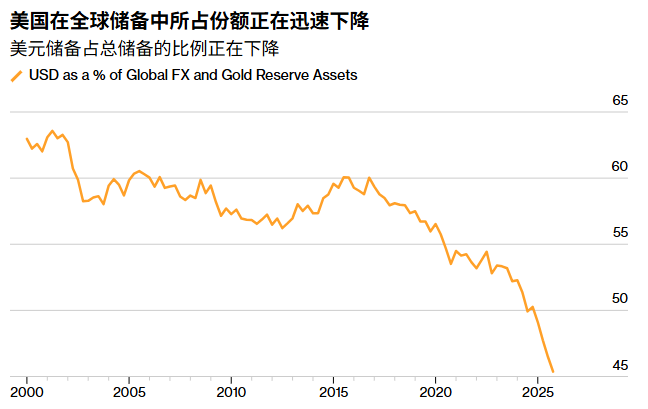
After adjusting for valuation effects, dollar-denominated reserves (i.e., reserves held by central banks) have, for the first time since the International Monetary Fund began publishing the data in the late 1990s, fallen below gold reserves.
The gold held by central banks around the world may have merely passively benefited from the historic rise in gold prices in recent years. But if we consider the adjusted value of dollar reserves as the “weight” of the currency, then since the official dollar holdings peaked around 2014, its weight has declined by 15%. Meanwhile, the physical gold holdings of central banks (almost all from emerging market countries) have increased by 15% in terms of tons. Therefore, it is hard to deny that the actual demand for the dollar has significantly weakened.
Amid growing distrust in the US dollar standard and the lack of viable asset alternatives that are separate from the financial system, the market has once again turned its attention to gold, the age-old solution, viewing it as the undisputed global collateral – which has had an adverse impact on the US dollar.
We can see this from the change in the behavior of global central banks. Before Russian assets were frozen, they were opportunistic dollar traders, buying when the dollar depreciated and selling when it rebounded. But now the situation is different. The decline in the dollar’s exchange rate in recent years has not led to substantial purchases.
There is a deeper and more persistent problem. The terms of exchange that underpin the global monetary system – namely, that trade surpluses are reinvested in dollar assets, allowing the United States to finance itself at low cost in return for security guarantees and stability of the global system – are no longer taken for granted.
First of all, for Middle East exporters such as Saudi Arabia, as their economies diversify and domestic investment increases, the surplus savings available for recycling have decreased.
If the United States is no longer regarded as a reliable guarantor of stability and security, then there will be a lack of motivation for people to conduct transactions in US dollars and recycle them back to the United States. The dollar cycle that underpins the global monetary system is facing increasingly severe pressure.
As mentioned earlier, this is not something that can be achieved overnight. The current lack of alternative reserve and financing assets can explain this situation, but it does not mean that there will be no loopholes and that the air will not continue to leak.
The rise in gold prices is just a warning. Other warnings are also growing louder. In the past few years, the share of the US dollar in global trade has dropped to around 40%, while the shares of the euro and the renminbi have rebounded; the proportion of international loans denominated in US dollars in the global total has fallen back to 60%; the amount of US Treasury bonds held by central banks is now lower than their gold holdings; and the share of the US dollar in global foreign exchange reserves and central bank gold holdings is rapidly declining.
Common sense is often the key to breaking established norms and overturning deeply rooted thinking patterns. After the United States unilaterally intervened in the war in Iran, everyone knew that the rules of the game had changed.
It is becoming increasingly reasonable to reduce holdings of dollar assets. It is now common sense that the dominance of the US dollar is bound to continue to weaken over time, while the value of gold will further rise.


