Tesla is expected to spend billions of dollars more this year to support Elon Musk’s ambition to transform the electric vehicle pioneer into an artificial intelligence and robotics company.
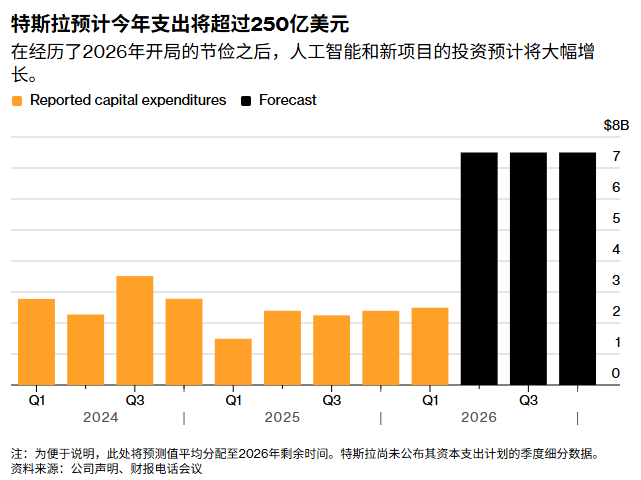
The company disclosed on Wednesday that its capital expenditure this year will exceed $25 billion, approximately three times that of last year. This investment plan is higher than the previous forecast of around $20 billion.
“You should see a significant increase in capital expenditures,” Musk said during Tesla’s earnings call after the release of its first-quarter results.
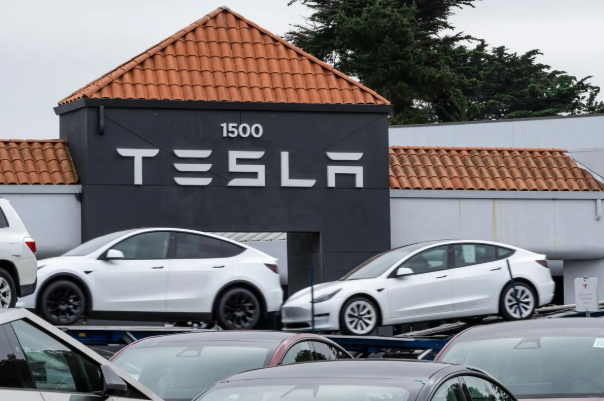
These investments will be used to significantly expand factory operations, including the production of Optimus humanoid robots, artificial intelligence projects, and Cybercab self-driving cars. Tesla’s traditional automotive business has continued to decline over the past two years, which has put more pressure on its transition to these future technology fields.
Dirk Muhrki, the managing director of SLC Management, said that the revised spending plan indicates that Tesla will have to pay a heavy price to achieve its goals. This “makes people more cautious in their assessment of the company’s potential for free cash flow this year.”
Tesla’s share price changed little in after-hours trading, erasing the gains made earlier in the day after executives announced an increase in spending expectations. As of Wednesday’s close, the stock has fallen by about 21% since hitting a record high in mid-December.
Tesla said that its adjusted earnings per share in the first quarter rose to 41 cents, higher than the average analyst estimate of 34 cents compiled by Bloomberg. This is the second consecutive quarter that the company has exceeded expectations.
The report indicates that Tesla’s core automotive business has a bright future. Tesla stated that in parts of Asia and South America, “demand for its vehicles continues to grow”, while the markets in North America and Europe-Middle East have also rebounded.
Just weeks after Tesla reported its January sales were lower than expected, the company made this unexpectedly optimistic statement. The first quarter was the second-worst quarter for vehicle deliveries since mid-2022, only better than the performance a year ago when Tesla halted Model Y production and dealt with the widespread controversy caused by Musk’s political activities.
In a report, Andrew Rocco, an analyst at Zacks Investment Research, said that the report “confirms that although the traditional electric vehicle business is no longer growing rapidly, it is stable enough to fund Tesla’s significant investments in robotics and autonomous driving technology.”
Tesla pointed out that the increase in gasoline prices is a major benefit for its business, driving up customer interest.
Chief Financial Officer Vaibhav Taneja said on the conference call: “On a quarter-on-quarter basis, there was a slight increase in the order backlog.”
Musk said that Tesla will increase car production through a capital expenditure plan. The CEO stated in a conference call that the company is “laying the foundation for a significant increase in car production in the future.”
However, in the first three months of 2026, Tesla’s spending was less than $2.5 billion – far below the average quarterly spending the company needed to meet its full-year spending expectations. This enabled Tesla to achieve a positive free cash flow of $1.4 billion in the quarter, far exceeding analysts’ previous expectations of nearly $1.9 billion.
After a frugal start in 2026, investment in artificial intelligence and new projects is expected to increase significantly.
The company’s energy and storage division reported a revenue of $2.4 billion in the first quarter, a year-on-year decline of 12%. Although the company did not elaborate on the reasons for the stagnation in the growth of this division (which has been a performance highlight in the past few years), Tanerja said, “The energy storage business is inherently volatile.” Tesla still expects its energy storage deployment this year to exceed the level of 2025.
The electric vehicle manufacturer reaffirmed its plans for an emerging ride-hailing business called Robotaxi, stating that the service is on track and will expand to Phoenix, Miami, Orlando, Tampa and Las Vegas in the first half of this year. Initially conceived as a driverless service, Robotaxi launched in Austin last year and has since steadily expanded. This month, the service was also rolled out in Houston and Dallas.
Although the company has not yet provided details such as the size of its fleet or disclosed how many vehicles are operating without on-board safety monitoring equipment, its development pace remains slow. Musk said that it will not achieve substantial profits until at least 2027. Tesla also offers ride-sharing services in the San Francisco Bay Area through the same app, but its model is more similar to that of Uber and Lyft.
Tesla said that the production of its key products is still proceeding as planned, including the Cybercab taxi, the Semi semi-trailer truck, and the upgraded Megapack battery energy storage system.
Ivan Feinseth, chief investment officer at Tigress Financial Partners, said that the spending to support production “will increase short-term cash consumption and execution risks, but could be beneficial to the stock price in the long run.” “Investors may increasingly view it as an AI computing and robotics infrastructure platform, not just an automaker.”