The United Arab Emirates’ sudden announcement of its withdrawal from OPEC caught its partners, with whom it has cooperated for six decades, off guard. Now, OPEC will have to strive to maintain its influence in the rapidly changing global oil market.
On Tuesday, officials from other member states were shocked as the long-standing tensions between Abu Dhabi and the de facto leader of the organization, Saudi Arabia, culminated in Saudi Arabia’s sudden announcement that it would withdraw from OPEC within days.
For OPEC and its partners, the UAE’s withdrawal will weaken their ability to manage oil prices through supply adjustments, and position the UAE as a wild card – and the UAE has long been dissatisfied with OPEC’s quota restrictions – at a time when the global market is experiencing unprecedented turmoil.
The most immediate impact is that the closure of the Strait of Hormuz has led to a significant drop in oil production in the United Arab Emirates and its Gulf neighbors, causing an extreme shortage of oil supply in other parts of the world and rendering OPEC quotas virtually meaningless. However, once oil supply resumes, the UAE’s withdrawal could eventually trigger a new round of market share battles and future price wars. Currently, UAE officials have indicated their intention to increase production.
Other officials from OPEC+ member countries said they do not expect a larger-scale oil outflow following the UAE’s move.
But the departure of one of the organization’s most influential members will still raise broader questions. In recent years, as new oil supplies have flooded the market, especially from US shale, OPEC’s influence has waned. Saudi Arabia has styled itself as the global market’s manager, but has struggled to rein in overproduction by other members. Meanwhile, over the past decade, the organization has also seen the exit of some of its smaller members.
Greg Brue, an analyst at Eurasia Group Consulting, said, “OPEC’s market power will weaken. The UAE’s exit will damage the organization’s credibility because the UAE’s production capacity accounts for a large portion of OPEC’s total capacity.”
The report is based on conversations with more than a dozen people familiar with the matter, most of whom requested anonymity because the information discussed was private.
Some insiders said that the UAE’s decision to withdraw from OPEC has been brewing for a long time and can be traced back to ten years ago.
These tensions reflect the ideological conflict between the two sides: on one hand, the UAE hopes to fully exploit its abundant oil and gas resources before the energy transition reaches a critical point; on the other hand, Riyadh prefers to manage crude oil production and prices more cautiously. This runs parallel to their competition for the status of the commercial center in the Middle East and for projecting political influence throughout the region.
The position of the United Arab Emirates has been shaped by a powerful figure in the emirate: Sultan Al Jaber, the CEO of Abu Dhabi National Oil Company, who often expresses dissatisfaction with the production limits imposed by OPEC+.
The United Arab Emirates has invested billions of dollars in new production capacity and is eager to recoup its costs, so it has significantly increased its output, exceeding the prescribed limit – this has drawn rare public condemnation from Saudi Arabia. Abu Dhabi had proposed to withdraw from the alliance, but ultimately did not follow through.
The UAE’s preparations for withdrawal accelerated towards the end of last year. Energy Minister Suhail Al Mazroui said in an interview that the turning point that ultimately led to this decision was the war in Iran.
“If oil production capacity slips out of the control of OPEC+, it will be bad news in the next three to five years,” said Clayton Siegel, a senior fellow at the Center for Strategic and International Studies. “This doesn’t mean OPEC+ won’t be able to manage the market successfully, but the obvious concern we all have to consider is the domino effect, with other alliance members potentially following Abu Dhabi’s lead in exiting. That’s what worries me the most.”
The significance of OPEC lies in its ability to balance the oil market, especially by cutting production when consumption is sluggish, such as during the 2008 financial crisis and the 2020 COVID-19 pandemic.
Nowadays, the responsibility of balancing supply and demand in the future will fall on the few remaining countries in the OPEC+ alliance led by Saudi Arabia and Russia. Although Riyadh has taken on the heavy responsibility of adjusting supply in the future, the commitment shown by other major member countries in the alliance, such as Iraq, Kazakhstan and Russia, is far less reliable than that of the Kingdom of Saudi Arabia.
Saudi Arabia has expressed dissatisfaction with the decline in its market share as some of its alliance partners have joined other global oil producers in ramping up oil output. Last year, Saudi Arabia led the OPEC+ alliance in a major strategic shift, abandoning the long-standing strategy of propping up oil prices in favor of increasing oil supply.
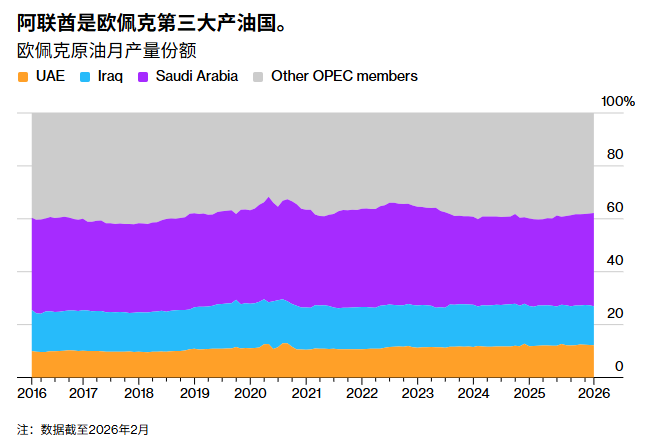
Although Abu Dhabi has rapidly expanded its production capacity and is ambitious to increase supply, it is still unclear how much room there is for further production growth. Estimates of the UAE’s oil output vary widely, but many analysts and traders believe that the country’s oil production was already close to saturation before the war. According to the International Energy Agency (IEA), the country’s output in February was 3.64 million barrels per day, much higher than the official figure. Some traders believe the actual output is even higher.
“The UAE’s oil production has long been at full capacity – they have ignored OPEC+ quotas,” said Gary Ross, a senior oil consultant and current hedge fund manager at Black Gold Investment. “In fact, it is Saudi Arabia that is balancing the market. Ultimately, OPEC is Saudi Arabia.”
The UAE’s withdrawal does not seem to lead to an immediate disintegration of the alliance. The alliance includes OPEC+ member states as well as other countries such as Russia and Kazakhstan. Many representatives stated that they neither plan to follow the UAE’s example in withdrawing nor believe that the UAE’s exit will trigger a larger wave of withdrawals.