Just three weeks after taking office, Federal Reserve Chair Kevin Warsh faces an extraordinary high-risk test.
Inflation is rebounding strongly at the fastest pace in three years. Disagreements among central bank policymakers are intensifying. Investors are selling U.S. Treasury bonds, betting that the Federal Reserve will begin raising interest rates in December—contrary to President Trump’s calls for rate cuts.
The outcome of this week’s Federal Reserve policy meeting is unlikely to be significant, as markets widely expect the Fed to keep its benchmark interest rate unchanged within the 3.5% to 3.75% range, while watching how energy price shocks triggered by the Iran conflict will affect the economy.
But Wash’s first press conference, along with the Fed’s post-meeting statement and forecasts, will be closely scrutinized for clues on the next steps.
If the Federal Reserve can send a convincing signal that it is willing to return to the path of fighting inflation, Wall Street might feel reassured by Wash’s commitment to preserving the Fed’s political independence. Otherwise, it could heighten market concerns, as investors were already worried that Wash might compromise with the White House and thereby undermine the Fed’s credibility.
“For him, this is an extremely difficult situation,” said James Claus, economist at the Andersen Institute and former deputy director of the Federal Reserve’s Monetary Affairs Division.
For a new Federal Reserve chairman, this has never been an easy task, and some, like Alan Greenspan or Ben Bernanke, faced major challenges shortly after taking office.
For Wall Street, however, the direct conflict between the White House’s priorities and economic trends is particularly thorny. Tensions have intensified due to skepticism over Wash’s views, further worsened by the complex outlook brought on by war and the surge in artificial intelligence investments—this boom is injecting fresh momentum into an economy that has already proven unexpectedly resilient.
During his tenure as a Federal Reserve governor from 2006 to 2011, Walsh was a firm hawk, at a time when the collapse of the housing market plunged the United States into a deep recession.
But in the following years, he turned into a vocal critic of the central bank, last year accusing it of persistently forecasting high inflation and claiming that artificial intelligence would unleash “powerful deflationary forces” by boosting productivity. Since taking the oath last month, Wash has remained silent—a common occurrence for a newly appointed chair seeking to familiarize himself with the situation—further complicating matters.
“He hasn’t talked about monetary policy in a long time,” said Ed Al-Husseini, portfolio manager at Columbia Trust Fund in New York. “So we’re all speculating about Wash’s views on monetary policy.”
Moreover, the economic landscape has shifted rapidly since Trump’s Iran war drove up oil prices. As business costs rose, companies passed them on to consumers, leading to higher prices and worsening inflation, which has remained above the Federal Reserve’s 2% target for the past five years. In May, the Consumer Price Index (CPI, a widely watched inflation gauge), rose 4.2% year-on-year—the largest increase since April 2023.
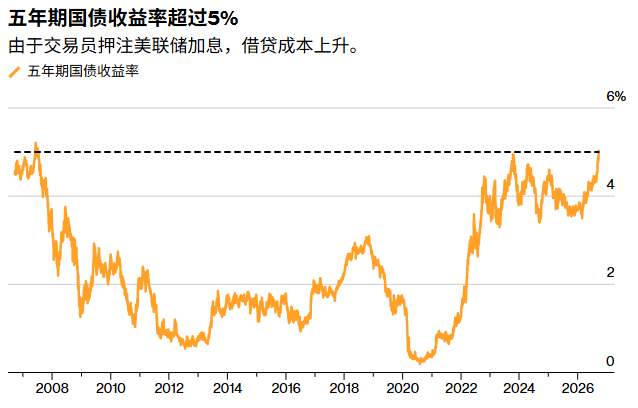
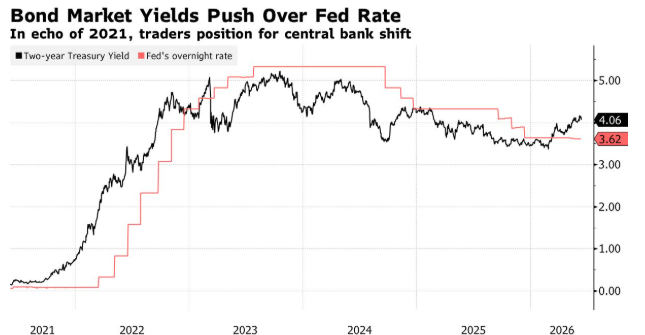
This has significantly shifted Wall Street’s expectations. Traders have abandoned their earlier widespread bets that the Federal Reserve would resume rate cuts this year, instead betting that the Fed will continue lowering interest rates. The yield on two-year U.S. Treasury notes has surged above 4%, surpassing the Fed’s policy rate, while the 30-year Treasury yield also hit its highest level since 2007 last month. Wall Street broadly interprets these two indicators as sending a clear signal to the market: interest rates need to keep rising.
Meanwhile, as Wash took over the role of central bank chief, the Trump administration was launching an unprecedented attack on the central bank, including attempts to remove Chair Lisa Cook and a criminal investigation. Wash’s predecessor, Jerome Powell, said the investigation was retaliation for the central bank not adjusting monetary policy in line with the president’s wishes.
Trump, when appointing Wash to the Federal Reserve Board, expressed respect for his independence. Yet Trump has repeatedly criticized Powell, stating this month that raising interest rates was wrong and insisting the Fed should cut rates instead.
Nevertheless, Wash pledged to carry out major reforms at the Federal Reserve, including strengthening cooperation with the Treasury Department. He stated that the Fed needs to change how it assesses inflation and communicates with the public, and advocated reducing the central bank’s massive bond holdings—a move that could force markets to absorb more bonds, thereby pushing up long-term interest rates.