Federal Reserve policymakers are expected to keep interest rates unchanged on Wednesday, an early test for new chair Kevin Warsh as rising inflation erodes household purchasing power and President Donald Trump continues to push for lower borrowing costs.
At his first meeting as Federal Reserve chair, Wash presided over the Federal Open Market Committee meeting. Several participants expressed growing concerns about persistently high inflation, with energy prices surging following the U.S. invasion of Iran further intensifying these worries. Multiple officials outlined various scenarios under which they believe interest rate hikes might be necessary and sought to remove any language in the post-meeting statement suggesting that a rate cut could come next.
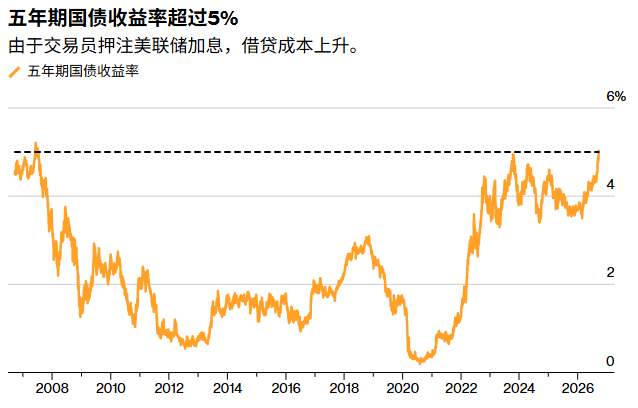
This shift in tone could become reality at this week’s meeting, forcing Wash to carefully balance competing interests. Prior to his nomination as Fed chair, Wash appeared aligned with Trump’s call for the Fed to cut interest rates. Now, the new chairman will have to navigate an inflationary environment and the views of his colleagues, making it harder to fulfill the president’s wishes. According to federal funds futures pricing, investors believe there is over an 80% chance the Fed will raise interest rates before December.
Investors will closely watch how strongly Wash supports the Fed’s commitment to bringing inflation back to its 2% target. Reporters may also press Wash on how news of a temporary peace agreement between the U.S. and Iran could affect his outlook on inflation and the overall economic prospects in the United States.
Michael Feroli, chief U.S. economist at JPMorgan, said: “If he fails to maintain confidence in the bond market, that will immediately have a negative impact, as interest rates could incorporate higher risk premiums, which would be detrimental to the overall economy.”
Policy makers are expected to release their latest quarterly economic forecasts and an updated “dot plot” (a chart showing officials’ expectations for interest rate movements) following this week’s meeting. Economists surveyed by Bloomberg News anticipate that officials will forecast a significant rise in inflation and delay the expectation of rate cuts until 2027, whereas previously they had projected one cut each in 2026 and 2027.
Given that Wash has publicly criticized forward guidance—the practice of signaling policy direction to investors—Fed watchers will closely examine the number of forecasts in the dot plot to see whether Wash was involved.
Wash is likely to be pressed again for details on the “institutional transformation” he promised the Federal Reserve. Wash has indicated that he will work to reform the Fed’s communication strategy, shrink the balance sheet, and reevaluate its inflation models. Most of these reforms would require support from other members of the Federal Open Market Committee (FOMC), and some may even need a formal vote. These policymakers are also expected to closely watch this press conference to assess whether Chair Wash’s views on the economy and potential institutional changes align with their own.
Federal Reserve watchers will also seek to assess how Wash will handle his relationship with Trump, who has consistently called for lower interest rates and exerted significant political pressure on the Fed. Critics of Wash argue that he cannot maintain sufficient independence from the White House, but he has dismissed these concerns.
Robert Tetlow, a former senior policy adviser at the Federal Reserve, said he will closely watch how much of Wash’s views retain those from his time as a researcher at the conservative think tank Hoover Institution and from his earlier years as a Fed governor, when he was known for aggressively fighting inflation.
“He might set some boundaries,” Tetlow said. “During the White House years, Wash would do whatever it took to lower interest rates regardless of economic conditions, whereas during the Hoover era, Wash was an inflation hawk.”