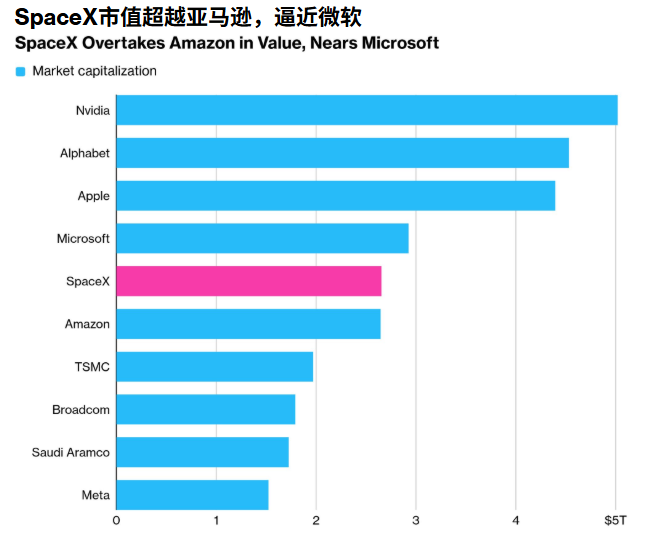
On Tuesday, SpaceX’s stock rose for the third consecutive day, surpassing Amazon in market value to become the fifth-largest publicly traded company globally. The stock closed up 4.8%, reaching a market capitalization of $2.65 trillion—about $8 billion more than Amazon. At one point during trading, the rocket and artificial intelligence company owned by Elon Musk surged past Microsoft, briefly becoming the world’s fourth-largest company by market value.
Since its listing, some of the volatility in SpaceX’s stock price has been due to its relatively small number of outstanding shares, with only about 4.2% of shares available for trading on the first day. This could lead to more volatile trading and make the stock price more susceptible to sharp fluctuations, rapidly changing its market value.
“This is one factor. We’re talking about a company whose market value is far higher than the number of its publicly traded shares,” said Angelo Kourkafas, senior global investment strategist at Edward Jones.
SpaceX’s stock price has risen 49% from its $135 IPO offering price, signaling sustained strong investor demand and easing market concerns that the record-breaking IPO was too large to absorb. SpaceX’s strong performance also paves the way for artificial intelligence rivals Anthropic PBC and OpenAI, which are expected to go public this year with valuations projected to reach $1 trillion each.
SpaceX announced on Tuesday that it has officially agreed to acquire AI programming startup Cursor, valuing the company at $60 billion. According to company filings, Cursor’s investors will receive SpaceX stock based on the implied equity value of Cursor.
According to Vanda Research, retail investors were also a key driver behind SpaceX’s strong stock debut, with their purchases in the first two days of trading equivalent to the total volume bought across the entire U.S. stock market last week.
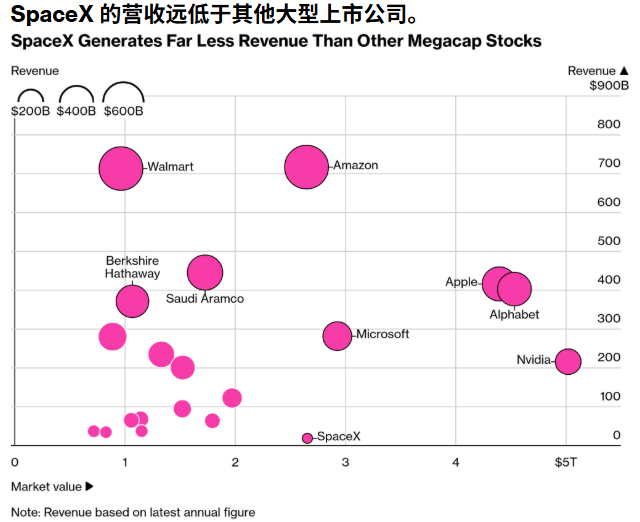
Although SpaceX is one of the world’s leading companies, its revenue is significantly lower than that of other tech giants. In 2025, SpaceX generated $18.7 billion in revenue, compared to Microsoft’s $281.7 billion and Amazon’s nearly $717 billion.
On Tuesday, SpaceX options contracts began trading on exchanges including Cboe Global Markets Inc. and Nasdaq Inc., which could further increase the stock’s volatility. Other options exchanges, including those operated by Intercontinental Exchange Inc. such as the New York Stock Exchange (NYSE) and Miami International Holdings Inc., are expected to list them in early next week.
When traders buy call options, the market makers on the other side hedge their risk by purchasing an equivalent amount of underlying stock, with the quantity matching their derivative exposure. As the stock price rises, this exposure increases, potentially forcing market makers to buy more shares to maintain position balance, thereby amplifying the upward momentum in the market.
Traders rushed into the market, betting that SpaceX’s stock price would rise further, with over 1.6 million options contracts traded.
“Floating rates are definitely part of it. Inclusion in the index is just around the corner, which will force passive funds to become forced buyers when tradable supply falls below 5%. The hedge between this mechanical demand and nearly zero supply will amplify every price fluctuation,” said Dave Mazza, CEO of Roundhill Financial.
Nasdaq has revised its rules to allow stocks of large companies like SpaceX to be included in its indices more quickly, making it likely that SpaceX will be added to the Nasdaq index within the coming weeks. This would support SpaceX’s stock price, as funds tracking the index would be required to purchase SpaceX shares. Meanwhile, S&P Dow Jones Indices has decided not to amend its rules to speed up new stock listings, meaning SpaceX will not be immediately included in the S&P 500 index.
However, market observers expect SpaceX’s stock to face greater downward pressure as so-called lock-up agreements expire one by one, allowing insiders to sell more shares. The first batch of shares will become eligible for sale after SpaceX releases its initial financial report, with some sales contingent on the stock price at that time. Meanwhile, all shares held by Musk will be locked up during the company’s first year of operation.
“We won’t know the true liquidation price until the lock-up period ends after the second-quarter earnings report and actual supply meets demand,” said Maza.