Morgan Stanley has cut its oil forecast for the second time in two weeks, as oil flow through the Strait of Hormuz recovered faster than expected, while strong U.S. supply and weak Chinese demand have heightened concerns over oil oversupply.
Analysts including Martijn Rats noted in a report that Brent crude oil—the benchmark for spot trading—is expected to average $75 per barrel in the third and fourth quarters, down by $15 and $5 respectively. They also lowered their price forecasts for all four quarters next year, projecting that Brent crude will fall to $70 per barrel by the end of 2027.
They noted in the report: “The pace of the Strait’s reopening has been faster than expected, but the ‘double-edged factor’ of strong U.S. exports and weak Chinese imports remains.” The report was released after a downward revision of forecasts in mid-June. “As attention turns to 2027, the market has completed a full cycle—returning once again to a state of oversupply.”
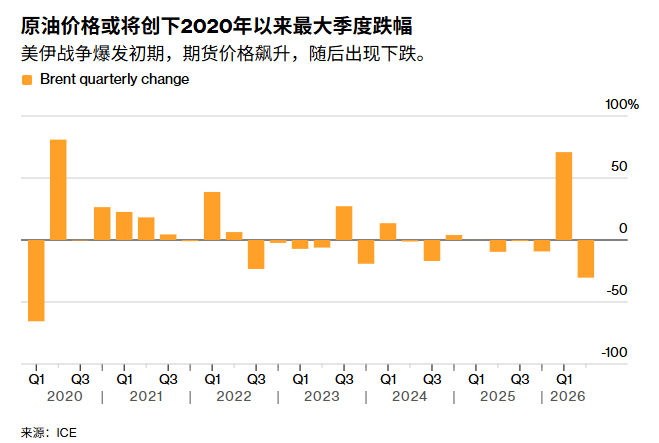
Global benchmark Brent crude oil futures have plunged about 30% this quarter, following a temporary peace deal between the U.S. and Iran that allowed partial resumption of shipping in the Strait of Hormuz. This rapid shift has prompted analysts to reassess their forecasts, with Goldman Sachs also lowering its expectations.
Although traffic in the Strait of Hormuz slowed during the weekend due to two vessels being affected, there are still signs that tanker companies are willing to continue sailing—a crucial step toward restoring normalcy in global markets and releasing millions of barrels of crude oil supply from the region.
Morgan Stanley reported that on Thursday, 35 oil and gas tankers passed through the Strait of Hormuz from the Persian Gulf, marking the first time since the conflict began in February that tanker traffic has returned to the pre-conflict normal level of 30 to 40 vessels per day. The firm noted that to achieve oil market balance by 2027, oil flow through the Strait of Hormuz needs only to recover to about 65% of its pre-conflict level—approximately 11 to 12 million barrels per day.
Brent crude futures prices surged to over $126 per barrel in April, but have since erased their wartime gains as Iran and the United States continue negotiations toward a permanent end to the conflict. On Tuesday, the most actively traded September contract was priced at $73.63 per barrel.
Morgan Stanley noted that the market has recently shown a series of easing signs, including a bearish futures premium pattern in crude oil futures—where the spot contract price is lower than the next contract—and some physical spreads have been “marked to loss.”
Analysts said, “Setting aside external narratives and focusing solely on price movements, the prices reflect an overall weakening market.”