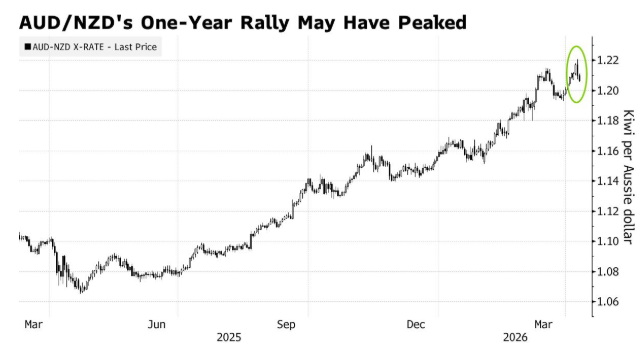
The year-long rally of the Australian dollar against the New Zealand dollar may have peaked, strategists say, as hawkish remarks from the Reserve Bank of New Zealand are boosting the appeal of the kiwi.
The New Zealand dollar retreated from a 13-year high on Wednesday after the Reserve Bank of New Zealand revealed that policymakers had discussed raising interest rates to deal with persistent inflationary pressures. On Thursday, the currency weakened further after Reserve Bank Governor Anna Paewai said the central bank would raise rates further if core inflation accelerated.
The shift in the Reserve Bank of New Zealand’s hawkish stance has weakened market expectations that the Reserve Bank of Australia’s interest rate advantage would push up the Australian dollar against the New Zealand dollar. Over the past year, these expectations had driven the Australian dollar to rise by more than 10% against the New Zealand dollar, but now this trend is losing its fundamental support.
“At present, it seems that the upside potential for the Australian dollar against the New Zealand dollar is somewhat constrained,” said Richard Franulovich, head of foreign exchange strategy at Westpac, when discussing the AUD/NZD currency pair.
The Australian dollar demonstrated relative resilience during the Iran war, but the unexpectedly hawkish monetary policy of the Reserve Bank of New Zealand may trigger broader unwinding of short positions in the New Zealand dollar, he said.
Westpac and ASB now predict that the Reserve Bank of New Zealand will raise interest rates in September, after the bank kept its hawkish rates unchanged last week. Previously, the prediction was for a rate hike in December. The swap market has fully priced in a 25 basis point rate hike in September and another one before the end of the year, and even a third rate hike could be on the cards.
This hawkish repricing strategy has narrowed the yield spread between the two countries’ government bonds. The yield spread between 10-year government bonds of Australia and New Zealand has dropped to 26 basis points, compared with 44 basis points in January, which was the highest level since 1996.
Jason Wong, a foreign exchange strategist at ANZ Bank, said in reference to the rise of the Australian dollar against the New Zealand dollar: “The Reserve Bank of New Zealand’s slightly hawkish policy shift has increased the possibility that we are approaching a turning point in this long-term upward trend.” However, “New Zealand’s relatively low interest rates compared to Australia remain a positive factor for the continued appreciation of the Australian dollar against the New Zealand dollar.”
Traders will be closely watching remarks by Reserve Bank of Australia Deputy Governor Andrew Holtham this week to see if he aligns with the hawkish stance of the Reserve Bank of New Zealand. Holtham said last month that further price pressures from the war are not good for the market.
The Reserve Bank of Australia raised interest rates for the second time in March. The swap market expects the central bank to raise rates twice more this year, each by 25 basis points. The next policy decision will be announced on May 5.
If the yield differential between the Australian dollar and the New Zealand dollar narrows slightly due to a reduction in market expectations of a hawkish stance by the Reserve Bank of Australia, some of the Australian dollar’s relative advantages may weaken, said Mazhar Jabin Zaman, head of foreign exchange research at Australia and New Zealand Banking Group Limited.
She believes that the exchange rate of the Australian dollar against the New Zealand dollar will remain within the range of 1.20 to 1.22 in the short term.


