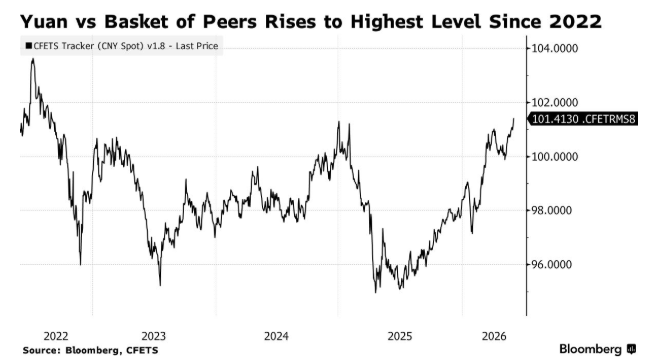
The renminbi rose to its highest level in nearly four years against a basket of trade partner currencies, highlighting the appeal of Chinese assets as regional safe havens amid the Iran conflict.
Data shows that Bloomberg’s simulated real-time CFETS basket index rose to 101.41 on Tuesday, reaching its highest level since September 2022, marking the third consecutive trading day of gains.
The yuan recovered after briefly weakening at the beginning of last month and has since maintained its index above 100 against the U.S. dollar. In May, the yuan rose 1% against the offshore dollar, outperforming most major Asian currencies.
Domestic clients have been net buyers of the yuan since last week, increasing upward pressure on the currency and cushioning the impact of the dollar’s rebound, according to traders who requested anonymity. The traders said they were not authorized to speak publicly on the matter. They also added that state-owned banks continue to supply dollars, but at a gradually declining pace, leaving more room for the yuan to appreciate.
Fiona Lim, senior foreign exchange strategist at Maybank, said: “The recent adjustment in the RMB’s mid-point suggests that the People’s Bank of China is satisfied with the currency’s strength, which aligns with their recent concerns about imported inflation. The trade-weighted strength of the RMB is likely to persist, especially as the U.S. dollar and U.S. Treasury yields remain high.”
However, China’s pursuit of exchange rate stability and potential dollar purchases by major state-owned banks may limit further appreciation of the yuan. Stephen Chiu, chief foreign exchange strategist for emerging markets at Bloomberg Intelligence, said policymakers might take measures including “significantly loosening the midpoint and providing more guidance windows by the People’s Bank of China within the domestic market to curb dollar selling.”
Chiu added that he is also monitoring the possibility of an increase in the foreign currency deposit reserve ratio, which would withdraw dollar liquidity from the domestic market.


