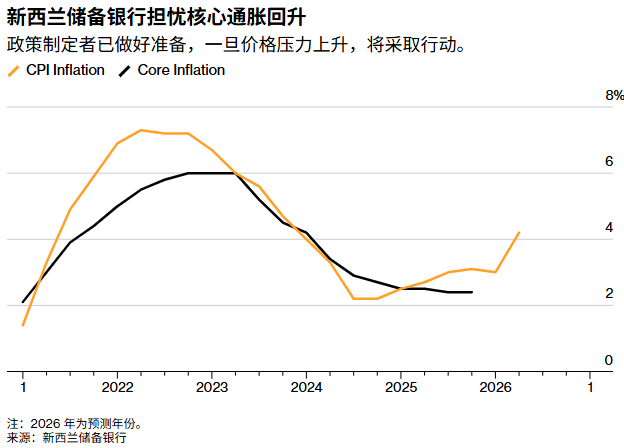
New Zealand’s central bank governor, Anna Bollard, said on Thursday that if core inflation accelerates due to the soaring fuel prices caused by the conflict in the Middle East, the country’s central bank will respond by raising interest rates.
In an interview with Bloomberg Television, Breman said, “The balance of risks regarding inflation has shifted, with upside risks being greater. We expect economic growth to slow slightly, but we are concerned that medium-term inflationary pressures could be higher. If we find that medium-term inflation starts to rise, we will take decisive action, which means raising interest rates.”
The day after the Reserve Bank kept the official cash rate at 2.25% unchanged, the governor gave a speech, emphasizing the firm determination to bring the inflation rate back to the midpoint of the 1-3% target range. The Reserve Bank expects the inflation rate to rise to 4.2% in the second quarter, but did not provide a complete forecast for this indicator or the trend of the official cash rate.
The money market believes that the Reserve Bank of New Zealand has more than an 80% chance of raising interest rates as early as July. Swap data indicates that the official cash rate is expected to reach 3% by the end of the year.
After Breman’s speech, the yield on two-year government bonds rose 10 basis points to 3.58%, continuing the earlier upward trend as traders raised their expectations for interest rate hikes.
Bremann said that policymakers will closely monitor any signs that inflationary pressures are building up in the medium term.
So, these factors include inflation expectations and wage growth. If we see core inflation – not just overall inflation, because we know overall inflation is bound to rise – but core inflation also rising, all of these could be reasons for raising interest rates.
Bollard said that the Reserve Bank of New Zealand’s strategy of focusing on controlling inflation is unlikely to lead to an economic contraction this year.
“We expect economic growth to be somewhat sluggish in the short term, but I think it would be unwise to make overly definite predictions about growth now, as the situation is highly uncertain,” she said.
Despite the ongoing conflicts in the Middle East, the White House announced that the United States will hold direct talks with Iran. With the Strait of Hormuz largely blocked and Israel’s attacks on Lebanon potentially undermining the fragile ceasefire agreement, oil prices rebounded after experiencing their biggest one-day drop since April 2020.
“Based on the fundamentals and the pre-conflict economic development direction, we still expect the New Zealand economy to grow somewhat this year. If the conflict is resolved, I am very confident that we will see some very good growth figures this year,” the governor said.


